Storz & Bickel · Complete Owner's Guide
Storz & Bickel Volcano Classic: The Complete Guide
"The Henry Hoover of desktop vaporisers — boring, analog, been in production for a quarter-century, and it will almost certainly outlive every other vape in your house. Here's how to get the best out of it."

The Volcano Classic is Storz & Bickel's original desktop vaporiser — launched in 2000 and still in production, unchanged, twenty-five years later. Pure convection heating through a ceramic element and aluminium heat exchanger, a forced-air fan, an analog temperature dial, and balloon-bag delivery. It produces vapour that's near-indistinguishable from the flagship Hybrid at a meaningful discount, and it's the most reliable piece of German engineering most owners will ever buy. This guide covers everything you need to own it well — setup, break-in, grind, the three-bag progression, the analog dial, cleaning, troubleshooting, and accessories.
- Setup time: ~10 minutes (one empty burn-off at dial 6 before first use, then a 5–6 minute pre-heat per session)
- Best temperature range: dial 5–7 (~180–195°C); dial 6 (~185°C) is the everyday sweet spot
- Cleaning interval: chamber after every session; screens weekly in isopropyl; valve housing deep-clean monthly
The 30-Second Version
What it is: Storz & Bickel's original desktop vaporiser, launched in 2000 and still in production unchanged twenty-five years later. Pure convection heating via a ceramic element and aluminium heat exchanger, forced-air fan, and an analog temperature dial with positions one through nine covering roughly 40°C to 230°C. Delivery is via replaceable balloon bags only (the Hybrid adds a whip option; the Classic does not). Mains-powered, 1.6 kilograms, made in Tuttlingen, Germany. No Bluetooth, no screen, no app, no firmware, no software bugs, no nothing — just a dial, a chamber, and a quarter-century of proven engineering.
Who it's for: Long-term buyers who care more about lifespan than features. Couples and small groups who share sessions via balloon. S&B purists who want the original Volcano experience. Medical users who need something simple enough for carers and family members to operate without a tutorial. Anyone who's ever been burned by a firmware update that broke their expensive kit. Owners of a Mighty+ or Venty who want a dedicated home setup that doesn't cannibalise their portable's battery life.
Who should skip it: Solo users who can't be bothered with balloons — get a Plenty or a Mighty+. Impatient users who can't handle a three-and-a-half-minute heat-up — get the Hybrid. Precision freaks who step temperatures by individual degrees — the analog dial has roughly eight usable positions and ±5°C accuracy. Anyone who wants a whip — the Classic doesn't have one, end of discussion. Stealth users — the fan is audible and a balloon is visible from orbit.
The honest truth: The Classic is the most reliable desktop vaporiser money can buy, and the price gap to the Hybrid is widening every year. It produces near-identical flavour and near-identical density at a meaningful discount. The trade-off is pure analog operation, a slower heat-up, and no whip. If you can live without the whip and the digital display, the Classic delivers 95% of the Hybrid experience for around 65% of the cost. The one honest caveat is that the plastic consumables — filling chambers, valve housings — will crack eventually, and those replacement costs add up over a decade. The heater itself is essentially immortal.
Before You Start — Authenticity, Break-In & Storage
Is Yours Real?
Volcano Classic counterfeits are mercifully rare — the manufacturing complexity of the ceramic heater and the precision fan assembly make cloning economically unviable, and nobody's bothered to try. That said, grey-market imports and refurbished-as-new scams do turn up. Buy from an authorised UK retailer like HerbVape.co.uk and you'll have zero drama. S&B maintain a formal UK distributor network, and authorised resellers can process warranty claims locally.
When the box arrives, check six things:
- Outer packaging — should carry a serial number and proper S&B branding. No blurry logos, no misspellings, no "Volcanoe" typos.
- The base unit — should feel substantial the moment you lift it out; 1.6 kilograms of solid German build quality isn't something you can fake.
- The dial — should have a satisfying notched rotation through positions one to nine, with no slop or free play.
- The fan — should kick in with a firm hum within a second of flipping the heat switch.
- The valve kit — the Easy Valve or Solid Valve set should include the correct balloon bags, mouthpiece, filling chamber, and screens.
- The bottom — should carry the WEEE registration number and CE marking.
If any of that looks wrong, send it back. Keep your receipt — you'll need it for warranty claims.
Breaking It In
S&B's official line is "no break-in required, just plug it in and go." My line is slightly different. Run the device empty at dial position six for about ten minutes before your first real session. The first time a new Classic heats up you may get a very faint metallic or plastic smell from the heat exchanger — this is residual manufacturing oils offgassing, it's harmless, and ten minutes of dry-firing clears it completely. Don't put herb in until this is done or your first bag will taste like a heating element.
The more important break-in step is psychological. This is an analog device. There is no temperature readout, no app graph, no firmware update to chase. Dial position six is roughly 185°C, position seven is roughly 195°C, and position eight is roughly 210°C. Stop looking for a digital screen, stop expecting precision, and start trusting the dial. After a week of use you'll know exactly where to put it for your preferred strains, and the "imprecision" of the analog system will feel like a feature rather than a bug.
Dennis's note: Don't fight the analog dial. I resisted it for a week coming off digital S&B devices, then realised the precision had been slowing me down. Set the dial to six, vape, nudge to seven on the third bag if you want to push the back end, and stop thinking about temperature entirely. Eight usable positions is plenty.
Storing It Between Sessions
The Volcano Classic is a mains-powered desktop with no battery to worry about. Store it on a stable surface where it won't be knocked over, keep it out of direct sunlight, and don't let it gather dust on the top vents — the fan will suck whatever's up there straight through the heating chamber. If you're not going to use it for a month or more, give it a quick wipe-down, store the balloon bag deflated (not inflated) to reduce stress on the seams, and don't coil the power cable tightly around the base. That's it. There's no firmware to keep updated and no battery to condition. This is a plug-it-in-and-forget-about-it device, which is exactly the point.
Full Specifications
| Manufacturer | Storz & Bickel GmbH, Tuttlingen, Germany |
| Launch Year | 2000 (renamed "Classic" in 2007 when the Digit launched) |
| Type | Desktop dry herb vaporiser, balloon delivery |
| Dimensions | 200mm height × 180mm diameter (20 × 18 × 18cm) |
| Weight | 1.6 kg |
| Heating Method | Pure convection — ceramic element + aluminium heat exchanger + forced-air fan |
| Heat-Up Time | 3 minutes 30 seconds to dial 6; up to 6 minutes at dial 9 |
| Temperature Range | ~40°C to ~230°C (104°F to 446°F) |
| Temperature Control | Analog rotary dial, positions 1–9, ±5°C accuracy |
| Chamber Capacity | 0.5g (with reducer / Solid Valve) to 0.75g (Easy Valve) |
| Delivery System | Balloon bag only — Easy Valve (disposable) or Solid Valve (refillable) |
| Vapour Path Materials | Ceramic heating element, aluminium heat exchanger, stainless steel screens, food-grade polypropylene balloon, silicone mouthpiece |
| Battery | None — mains-powered (220–240V / 50–60Hz UK) |
| Bluetooth / App | None — fully analog |
| Auto Shut-Off | 30 minutes of no fan activity |
| Warranty | 3 years standard from authorised retailer purchase |
| Certification | TÜV SÜD approved, DIN EN ISO 60335 compliance, medical-grade materials (no glass in vapour path) |
| Price (UK) | £266.99 at herbvape.co.uk (authorised UK dealer) |
First Impressions
Unboxing a Volcano Classic in 2026 is a strange experience. The packaging is plain, the device inside looks like it was designed during the Clinton administration, and there's no software to download, no account to create, no welcome email. You lift it out, you plug it in, you turn the dial, and you vape. Compared to the weeks of setup ritual that come with modern portables — firmware updates, app pairing, ECO charging configuration, user profiles — the Classic is refreshingly brutal in its simplicity. My first thought when I lifted mine out of the box was "this is it?" My second thought, about fifteen minutes later, was "oh, this is it."
The build is immediately reassuring. The base unit is a solid cone of painted aluminium with heft that tells you it wasn't designed to be carried anywhere. The dial has a precise, notched rotation that feels like a high-end kitchen timer — no slop, no wobble, no plastic creak. The heat switch is a chunky red toggle. The fan switch is a chunky black toggle. The entire front panel looks like something bolted to a piece of industrial machinery from a West German factory in 1987, which is not a coincidence — this is medical-grade product design wearing its influences openly. It's not pretty in the way a modern Apple-style device is pretty. It's honest. You look at it and you know exactly what every control does without reading a manual.
Dave's 2008 Classic, which I've handled dozens of times, feels identical to the one I bought new in 2024. The dial has the same resistance, the fan has the same tone, the heat exchanger glows the same dim orange through the chamber base. He dropped a pint glass onto his in 2015 — a proper full, cold, Friday-night London Pride that chipped the paint near the mouthpiece recess and spilled stout into the fan housing. He unplugged it, towelled it dry, left it on a radiator for three days, plugged it back in, and it's worked ever since. That's sixteen years and counting, one accidental beer shower, zero service visits. My Mighty+ has been back to Storz & Bickel twice in three years. There's a lesson in that.
The one thing you notice immediately, and it's worth flagging: the plastic parts are not made of the same stuff as the metal body. The filling chamber and the valve housing are thinner, lighter, cheaper-feeling polymer, and they don't inspire the same confidence. More on that when we get to Troubleshooting.
What Makes It Tick
The Ceramic Heater and Aluminium Heat Exchanger
The Classic uses a ceramic heating element — inert, stable, rated well above the 230°C operating maximum — paired with a grooved aluminium heat exchanger that the fan pushes room air through. The air is heated on the way through the exchanger before it reaches your herb, which is the definition of pure convection. Nothing in the vapour path is touching a hot surface directly; the herb sits in a stainless steel-screened chamber that's above the heater, and the hot air passes up through it and into the balloon. This is why the flavour is so clean and why the extraction is so even — there's no hotspot, no conduction ring trying to "boost" early hits, and no temperature overshoot on contact.
The design is twenty-five years old and it has not been meaningfully changed since launch. That's not laziness, that's confidence. S&B figured out in 2000 that forced-air convection through a ceramic heater was the best way to vaporise dry herb, and nobody has come up with anything that beats it on pure flavour. The Hybrid added a conduction ring for speed and responsiveness; the Classic stuck with the original design for purity. When people say "the Classic tastes rounder than the Hybrid," what they mean is that pure convection has no early-session edge from conduction contact. It's slightly slower to deliver and slightly cooler to the tongue, and for a lot of people that's the point.
The Analog Dial — Why It's Better Than You Think
I resisted the analog dial for about a week. I came to the Classic from the Mighty+ and the Hybrid, both of which have digital displays and single-degree precision, and the idea of "roughly 185°C, give or take five" felt like a step back. Then I spent two weeks with it and realised the precision had been slowing me down. On digital devices I was constantly nudging the temperature by two or three degrees looking for the "right" setting and never quite landing on it. On the Classic I set the dial to six, I vape, I nudge to seven on the third bag if I want to push the back end, and I stop thinking about temperature entirely. Eight usable positions is enough.
The accuracy is roughly ±5°C on a well-calibrated dial. That sounds imprecise until you realise that cannabis terpenes boil across broad bands, not at exact single-degree thresholds, and that the actual chamber temperature fluctuates by more than ±5°C during a session regardless of what any display says. The Classic's dial is honest about its imprecision in a way that digital devices hide from you.
The Balloon System — Easy Valve vs Solid Valve
The Classic ships with either the Easy Valve system (disposable balloon/valve assemblies that replace as a single unit) or the Solid Valve system (a refillable valve with separate replacement balloons). Easy Valve is cheaper up front, simpler to use, and has no cleaning burden — when it's expired you throw it away and fit a new one. Solid Valve is more expensive up front, supports indefinite balloon replacement and deep cleaning of the valve body, and is the long-term option for heavy users. My recommendation: if you're using the Classic daily, buy the Solid Valve kit. If you're using it a few times a week, Easy Valve is fine and the disposability is a genuine convenience.
Balloon material is food-grade polypropylene — the same plastic used in microwaveable containers and baby bottles. It's inert up to well above the vapour temperature by the time it reaches the bag, and terpene condensation inside the balloon is minimal if you inhale promptly. Letting a bag sit for ten minutes before finishing it will dull the flavour measurably.
The Analog Thermostat and Why It Almost Never Fails
This is the part that people miss. The Classic's temperature control is regulated by a mechanical bimetallic thermostat, not a microprocessor. There is no PID loop, no thermistor calibration curve, no firmware correction. The dial directly adjusts the target temperature and the thermostat cycles the heater to maintain it. This has two consequences. First, the temperature regulation is slightly less precise than a digital device — you'll see a small overshoot and a slow cycle as the heater bangs on and off. Second, and more importantly, there is essentially nothing to break. A mechanical thermostat rated for this duty cycle will outlast every silicon chip S&B could have put in its place. The ceramic heater has a similarly mean-time-to-failure measured in decades rather than years. This is why sixteen-year-old Classics still work. It's not nostalgia — it's because the failure surface is deliberately tiny.
The Plastic Problem
I love the Classic. I also need to be honest about the bit that isn't built like a Swiss watch. The filling chamber, the valve housings, and some of the balloon adapter parts are made of a polycarbonate-type polymer that is meaningfully more fragile than the metal body. Heat cycling, being left sat on top of the unit while it's still hot, and general wear will cause hairline cracks around the chamber wall at roughly dial-six operating temperatures within a couple of years of heavy use. Mine developed one within about three months of daily use — I think I'd left the chamber on top of the unit between sessions, which is the operating-error part. Replacement chambers are around £20 from S&B, they're in stock permanently, and swapping them takes thirty seconds. It's not the end of the world. But if your mental model of "Volcano ownership" is "buy once, never replace anything," the plastic bits are where that model hits a wall.
The angle I want you to take away is this: the Classic is a tank-like core heater with cheap-feeling plastic appendages. The core lasts a lifetime. The appendages are consumables. Budget for the plastic bits and you'll be fine.
Dennis's Golden Rule for the Volcano Classic: If you can live without the whip and the digital dial, the Classic is the Volcano to buy. The heater is immortal, the plastic bits are replaceable, and the vapour has never been beaten.
The Knack — How to Actually Get the Best From It
Every S&B device has a knack — the moment where the advertised workflow and the actual best workflow diverge. The Classic's knack is this: grind medium, pack firm, and stop messing with the dial mid-session.
S&B's manual will tell you to load the chamber, screw it onto the top of the heater, fill a bag, detach, inhale. This works. But the owners who get the best out of their Classic do three things differently. First, they grind slightly finer than the manual suggests — around the coarseness of coarse ground coffee, not the fluffy texture that works in the Mighty+. This is because the Classic's convection path is wider and slightly less aggressive than a portable's, so a finer grind gives better surface area and more even extraction. Second, they pack the chamber firmly — not packed like espresso, but a good thumb-press down so the herb doesn't bounce around when the fan kicks in. A loose chamber delivers uneven bags. Third, and this is the big one, they set the dial at the start of the session and leave it there. The Classic's thermostat doesn't respond instantly; if you turn the dial mid-bag the heater has to catch up and your second bag ends up in the wrong temperature zone. Pick a setting, commit to it, and step it up only between chambers, not between bags.
The other bit of knack that isn't in the manual is the pre-heat. S&B say 3–4 minutes to heat. In practice, the optimal workflow is to turn the heat on, set the dial, and leave it for a full five to six minutes before you load any herb. The extra minute or two ensures the aluminium exchanger is fully saturated rather than still climbing, and the first bag will be dense and consistent with the second and third. Starting too early gives you a light first bag that tastes thin. I use the five-minute window to pack the chamber, grind for the next strain, and put the kettle on. By the time the tea's brewed, the Classic is ready.
Finally: don't overfill. The chamber will hold 0.75g comfortably but it will give you four dense bags at 0.5g rather than six mediocre ones at 0.75g. Solo users should buy the Chamber Reducer accessory and load 0.3–0.4g per session. Sharing? Load the full 0.75g. But don't assume more herb equals more vapour. The convection efficiency peaks at around the two-thirds-full mark.
Grinding for the Volcano Classic
The Classic is slightly more forgiving on grind consistency than any portable I own, but there's still a sweet spot. You want a medium grind — not the fluffy fine grind that suits the Mighty+, and not the coarse grind that suits lower-powered convection devices. The consistency should look roughly like coarse ground coffee. If the particles are too fine they compact under the fan's airflow and create hot spots; if they're too coarse the convection passes over the surface without extracting the inner particles.
Use a two- or four-piece grinder with sharp teeth. A cheap plastic grinder will deliver an inconsistent cut and your bags will be uneven from one to the next. I've used a Santa Cruz Shredder medium for years and it's outlasted two partners and one flat move. If you're loading the reducer chamber for solo sessions, grind finer — around the consistency of a decent espresso grind — to compensate for the smaller load and make the most of the reduced airflow area.
Pack the chamber with a gentle thumb-press; firm enough that the herb doesn't bounce, loose enough that air can still pass through freely. Don't tamp it like an espresso puck — you'll restrict the fan and the Classic will struggle to fill the bag. The chamber screen should be visible through the mesh at the top after loading; if the herb is flush with the top of the chamber, you've overpacked.
Temperature & Strain Guide DIAL 1–9
The Classic's dial positions map roughly to the following temperatures. These are ±5°C because of the analog thermostat, and slightly dependent on room temperature and unit age.
| Dial | Approx °C | Approx °F | Vapour Character | Best For |
|---|---|---|---|---|
| 1 | ~125°C | ~255°F | Barely there — no visible vapour, subtle flavour | Microdose / flavour-only tests |
| 2 | ~140°C | ~285°F | Light, very flavoured | Daytime, CBD-heavy strains |
| 3 | ~155°C | ~310°F | Light-medium, terpene-forward | Sativa daytime use |
| 4 | ~170°C | ~340°F | Medium, balanced | Start here for most strains |
| 5 | ~180°C | ~355°F | Medium-dense, clear effects | Social sessions |
| 6 | ~185°C | ~365°F | Dense, balanced — Dennis default | Hybrids, most daily drivers |
| 7 | ~195°C | ~380°F | Dense, heavier | Indica evenings |
| 8 | ~210°C | ~410°F | Heavy, sedating, some combustion risk | Night, full extraction |
| 9 | ~225°C | ~440°F | Extraction push, edge of combustion | Finishing a spent chamber |
Dennis's Special — the three-bag progression: The Classic is made for multi-bag sessions, and the best way to extract a chamber completely is to step the dial between bags. Start at dial 5 for the first bag — this pulls the terpenes and the lightest cannabinoids while the chamber is still fresh. Step to dial 6 for the second bag — the peak of the extraction curve for most strains, where the vapour density is highest and the flavour is most balanced. Finish at dial 7 or 7.5 for the third bag — this pulls the heavier cannabinoids and the residual terpenes from the spent herb, and the resulting bag is heavier and more sedating than the first two. One chamber, three distinct bags, progressively stepped. Nothing else I own does this as elegantly.
Strain tip: Northern Lights (pure indica, myrcene/pinene dominant) runs beautifully across dials 6, 7 and 8 on a fresh 0.5g load — pine-forward and clean first, sedating and myrcene-heavy by the third bag. Purple Haze (85% sativa, limonene/terpinolene-forward) wants dials 5, 6 and 7.5 — bright and citrus-forward on the first bag, earthy caryophyllene backbone on the second, heavier on the finish. Sarah walked past mid-session, sniffed once, and declared Purple Haze "the nice one." She's right.
Advanced Techniques
The Chamber Reducer accessory is essential for solo use. The full Easy Valve chamber is built for 0.5–0.75g loads, which is two people's worth of herb, and solo users who fill it at that level will waste money. The Reducer drops the effective chamber to about 0.25–0.3g, delivers one to two dense bags per session, and transforms the economics of owning a Classic when you're the only one using it. It's about fifteen quid, it takes two seconds to fit, and it pays for itself in a week.
Liquid pads for concentrates: S&B sell a small pad accessory that allows the Classic to vaporise small amounts of concentrate or infused oil. Place a drop or two on the pad, insert it above or below the herb load in the chamber, and the convection will vaporise it alongside the flower. This is not a serious dab rig — don't try to run pure concentrate sessions on the Classic — but it's useful for adding a bit of potency to a flower bag or for using up small amounts of oil without a dedicated e-rig. The pads are cheap and reusable with a quick isopropyl soak.
Stepped temperature sessions: because the Classic's thermostat responds slowly, the best way to do a stepped-temperature session is to commit to the full three-bag progression above and simply turn the dial up between bags while the fan is off. The heater has about thirty seconds of thermal mass, so the transition between bags at different dial positions is smooth and the second and third bags arrive on-target without a long wait. This is what the analog design actually wants to do.
Chaining chambers for group sessions: if you're running a session for four or more people, load three or four chambers ahead of time into spare filling chambers (you'll need to buy extras — about £20 each), run the first bag while the next chamber is being packed, and rotate chambers through the session. The fan handles continuous use for hours without any thermal throttling, and the ceramic element will run indefinitely at a steady dial setting. Doing a four-person session with the Classic is the closest thing I've experienced to hosting at a hookah bar without the charcoal.
On firmware: there isn't any. The Classic is fully analog. There's no app to update, no firmware to break, no software to patch. If your device works out of the box it will work in ten years without any intervention. If you want Bluetooth and app control, that's the Volcano Hybrid — the Classic deliberately doesn't.
Cleaning, Maintenance & Warranty
The removable chamber and valve carry almost the entire cleaning burden here — the base unit itself barely needs attention. Here's the routine that keeps a Classic tasting like new.
- Daily: empty the chamber after each session and brush it out with the included brush. Thirty seconds. Don't let spent herb sit in a warm chamber overnight — it'll gum up the screens.
- Weekly: pop the screens out of the chamber, soak them in 90%+ isopropyl alcohol for 10–15 minutes, rinse, dry, and refit. Wipe the filling chamber body with a cloth dampened in isopropyl. Check the balloon for tearing or delamination at the seams.
- Monthly: deep-clean the valve housing by detaching it from the balloon and soaking the internal parts in isopropyl for 30 minutes. The silicone mouthpiece can go in with them. Rinse thoroughly, air-dry, reassemble. Wipe the fan intake vents clean — a dusty fan reduces airflow and slows bag-fill.
- Balloon replacement: Easy Valve bags should be replaced when you notice condensation inside, a dull flavour, or any visible tearing — typically every 1–3 months with regular use. Solid Valve bags last longer and you're only replacing the bag, not the whole valve assembly.
Never soak the base unit — it's mains-powered electronics and it isn't waterproof; there's no need to clean it internally and you'll kill it. Never leave the plastic filling chamber sitting on top of the unit while it's still hot — that's the single biggest cause of hairline cracks. And never use anything other than 90%+ isopropyl alcohol on the screens and valve parts.
Warranty reality check: S&B offer a 3-year warranty on the Classic from purchase through an authorised retailer. This covers electronic and heater failures but does not cover the balloon, the silicone mouthpiece, the screens, or the filling chamber — those are consumables. Some retailers and older marketing materials reference a longer "registered" warranty of up to 10 years, but this isn't confirmed by current research and I'd treat any 10-year claim with caution. Route any warranty claim through your UK retailer rather than shipping to Germany directly — the UK authorised resellers can process S&B claims locally and save you six weeks of international shipping. To claim through herbvape.co.uk, email info@herbvape.co.uk with your order number and a short description.
Here's the reality nobody mentions: S&B's warranty is excellent for genuine heater or electronic failures within the term, but owners who push for free repairs on 20-month-old units have occasionally hit refusals. One documented case had a repair quoted at around €160 for a full "replaced the insides" rebuild. That's the bad news. The good news is that sixteen-year-old Classics are still working on the original heater, which means most owners will never need warranty service at all. The core is nearly immortal. It's the consumables that cost you money over time, and those aren't under warranty anyway.
Troubleshooting
| Symptom | Likely Cause | The Fix |
|---|---|---|
| Filling chamber develops hairline cracks | Heat cycling plus chamber left sitting on hot base between sessions | Replace chamber (~£20 from S&B); don't leave chamber on top of unit when hot — set it aside. |
| Weak first bag, normal second and third | Unit not fully heat-soaked before first bag | Wait a full 5–6 minutes from heat-on, not 3–4, before loading and filling the first bag. |
| Fan runs but no heat, or heat but no fan | Independent toggle switches — one is in the off position | Check both the red (heat) and black (fan) switches are on. |
| Vapour tastes thin and cool even at dial 6+ | Balloon old or clogged with condensation, or unit needs a deep clean | Replace balloon; deep-clean screens and chamber in 90% isopropyl. |
| Faint plastic or metallic smell | Residual manufacturing oils on new unit, not yet broken in | Run empty at dial 6 for 10 minutes; repeat once if needed. |
| Dial feels loose or cycles without resistance | Internal dial detent spring worn or unseated | Warranty claim if within 3 years; otherwise S&B repair quote — rare failure. |
| Fan noise changed to rattle or whine | Dust in the fan intake or early bearing wear | Clean the intake vents; if noise persists after cleaning, book a service. |
| Heat unstable between bags — first cool, second hot | Analog thermostat cycling normally, plus premature dial adjustments | Set dial and leave it; step only between chambers, never mid-session. |
| Device won't turn on at all | Kettle lead or mains socket fault | Test the socket with another device; replace the C13 kettle lead if suspected. |
| Old unit (10+ yr) seems to "need a slap" to heat | Aged thermostat or ceramic heater nearing end-of-life | On a 10+ year-old unit this is end-of-life; S&B repair (~€160) is essentially a rebuild. Budget for it or retire the unit. |
Real Talk
The following are composite profiles based on community feedback, owner correspondence, and real reports from Volcano Classic users. Names are edited; the details and experiences are real.
"Bought my Classic in 2017 after my Arizer Extreme Q packed in. It's been running for nine years straight, bang on, no issues with the heater or the fan. The filling chamber cracked about two years ago and I replaced it for £22 — annoying but hardly catastrophic. The thing I didn't expect is how much I've come to love the analog dial. I don't miss the digital screen at all. It's become part of the ritual." — Pete, 52, Bristol · nine years of ownership
"We run ours at dinner parties — four of us sharing bags through the Easy Valve — and it's become the centrepiece of the evening. Nobody wants to go home until the last bag's done. We've replaced the balloon once in three years and that's it. My husband still calls it 'the beige calculator' but he uses it more than anyone else." — Hannah, 44, Edinburgh · three years of ownership
"Had a really dodgy experience at about 20 months — mine started cycling wrong, the heat was all over the place, and S&B pushed back hard on the warranty claim. In the end I paid €160 for the full rebuild and it's been perfect since. Mixed feelings on the warranty support but the rebuilt unit has run flawlessly for four years now. I'd buy another one but I'd register it the day it arrives and keep all the paperwork." — Rob, 38, Leeds · five years of ownership
Accessories Worth Buying
- Chamber Reducer (~£15) — essential for solo users. Drops the effective chamber to 0.25–0.3g and pays for itself within a week. If you're the only person using your Classic, buy this before anything else.
- Spare Easy Valve kit or Solid Valve upgrade (~£25–£60) — balloon and valve will need replacing eventually. Keep one spare in the drawer so you're never stuck mid-session with a torn bag.
- Quality four-piece grinder (~£30–£70) — Santa Cruz Shredder medium, SLX, or similar. Cheap grinders deliver inconsistent cuts and the Classic's convection wants consistency.
- Extra filling chambers (~£20 each) — useful for group sessions where you want to pack ahead. One extra is the sweet spot for most owners.
- Liquid Pads (~£8) — for occasional concentrate use alongside flower bags. Cheap, reusable, worth having in the kit.
Skip: third-party "premium" balloon bags (S&B's own bags are cheap and perfectly engineered — aftermarket bags risk seal leaks and flavour issues), any app dongle or Bluetooth module marketed for "upgrading" the Classic (they don't exist officially and anything claiming to be one is a scam — buy the Hybrid if you want Bluetooth), and expensive branded "cleaning kits" (a bottle of 90%+ isopropyl, cotton buds, and the included brush are all you need).
How It Compares
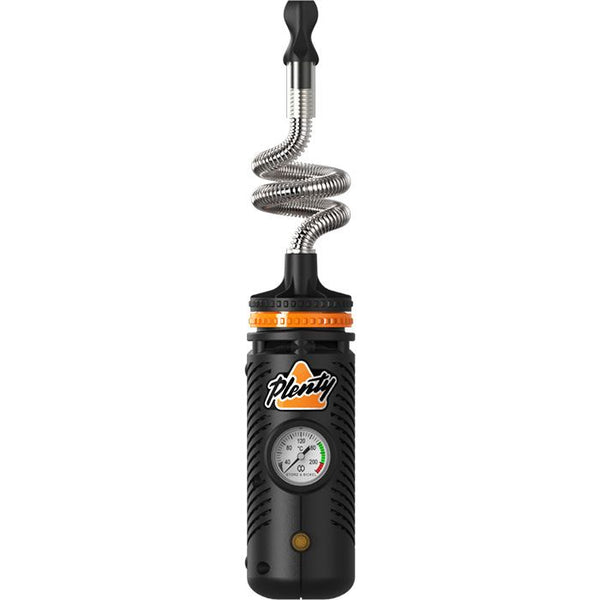
If you're weighing the Classic against the obvious alternatives, here's the short version. The Volcano Hybrid is faster (roughly 90-second real-world heat-up), app-connected, digital, and adds a whip — but costs about £141 more. The Plenty is a corded hand-held with a whip, better for solo direct-draw sessions and £99 cheaper. The Arizer Extreme Q delivers genuine balloon-and-whip convection at under half the price, but without the German build quality, vapour density, or fifteen-year service life. The Classic's whole pitch is total cost of ownership: it outlasts everything in the category.
| Feature | Volcano Classic | Volcano Hybrid | S&B Plenty | Arizer Extreme Q |
|---|---|---|---|---|
| Price (UK) | £266.99 | £407.99 | £167.99 | £89.00 |
| Temp control | Analog 1–9 | Digital 40–230°C | Analog 130–202°C | Digital |
| Heat-up | 3:30–6 min | ~90 sec | ~2 min | ~3 min |
| Delivery | Balloon | Balloon + whip | Whip | Balloon + whip |
| Connectivity | None | Bluetooth | None | Remote (IR) |
| Build | German metal | German metal | German metal | Plastic + glass |
| Longevity | 15+ years | 10+ years | 10+ years | 5–8 years |
The £141 gap to the Hybrid buys you speed, precision, and the whip attachment. If those three things are non-negotiable, get the Hybrid. If they're not, the Classic gives you around 95% of the vapour quality for roughly 65% of the price, and the analog design has an extra decade of longevity baked in.
FAQ
Ready to bring the Volcano Classic home?
£266.99 · with code DENNIS5: £253.64
Shop Volcano Classic →Worth Grabbing With It
- Chamber Reducer — essential for solo use. Drops the effective chamber to 0.25–0.3g and pays for itself in a week.
- Spare Filling Chambers — for group sessions, pre-load multiple and rotate through the evening.
- Easy Valve Balloon Replacement Set — the bags are consumables. Stock up so you're never stuck mid-session.
Use code DENNIS5 at checkout for 5% off any vaporizer.