Quit Combustion
Why Cigarettes Taste Like Chemicals After You Vape (And Why That's Your Body Being Smart)
"Your body isn't overreacting. It's finally telling you the truth."

Once you've spent a few months off combustion, your taste buds rebuild and your brain stops getting nicotine-amplified pleasure cues — which means the next time someone hands you a spliff or a cigarette, it'll taste exactly like what it actually is: tar, benzene, formaldehyde, and over four hundred other volatile compounds. That gag reflex isn't you being precious. It's your now-functional palate correctly identifying poison.
Your taste buds aren't broken. They're healing. The fact that the old habit now tastes revolting is the first clean piece of feedback your body has given you in years.
The Gag Reflex I Didn't See Coming
Right, so it's a Saturday night in Manchester at a mate's birthday. I've been off combustion long enough that my flat doesn't smell like a coffee shop in a tumble dryer anymore, Sarah's stopped passive-aggressively spraying Febreze, and I've started having opinions about olive oil — which is how you can tell a man's ruined by the recovery of his palate.
It's 2am. Everyone's had a few. Someone passes me a spliff.
You know that thing where you do something on autopilot? Muscle memory from twenty-odd years of smoking? I took it. Put it to my lips. Inhaled.
I nearly threw up.
Not metaphorically. Not "oh that's a bit harsh." I mean properly gagged like I'd just licked an ashtray that someone had doused in nail polish remover. The taste was so overwhelmingly chemical, so aggressively wrong, that my body just went "absolutely not, mate" and tried to eject it immediately.
Jake saw my face and said: "Fuck me, Dennis, you alright?" Here's what I wanted to say: "My taste buds have spent months regenerating after the better part of twenty years of thermal abuse, and what you've just handed me tastes like burning a tyre soaked in formaldehyde, and my now-functional palate is correctly identifying this as poison." Here's what I actually said: "…cough… Wrong pipe. I'm good." I wasn't good. I spent the next twenty minutes outside in the smoking area (ironic, I know) trying to get the taste out of my mouth with three pints of water and a packet of chewing gum.
That was years ago now — I switched at 34 and I'm 42 — but I can still taste that spliff. If you've switched from smoking to vaping and you've had a similar experience, you're not broken. You're not being dramatic. Your body isn't overreacting. Your body is finally telling you the truth.
This is the article I wish I'd read before that birthday, back when I thought "switching to vaping" was just a consumption method change and not a complete sensory recalibration. (If you're worried about handling the social pressure at moments like this, I covered that in You've Changed, Man.)
The Biology: Your Tongue Is Constantly Rebuilding Itself
Let me start with the science that made me feel significantly better about the whole gagging-at-a-party incident.
Your taste buds aren't permanent. They're not like tattoos or that embarrassing haircut from 2005 that lives on in your Facebook photos. They regenerate constantly.
Sarah made me cite my sources after I kept saying "studies show," and delivered the line "you sound like a man who's about to be wrong on the internet" with the patience of a woman who's watched me read too many abstracts.
According to peer-reviewed research, the taste receptor cells in your taste buds have a remarkably short lifespan:
- Standard regeneration cycle: 10–14 days.
- Individual cell lifespan: 10 days to about 6 weeks.
- Complete turnover: every 2 months, all your taste bud cells are new.
Think about that for a second. Every 10–14 days, you get a refresh. But here's the problem: smoking damages those taste buds faster than they can regenerate properly.
How Smoking Destroys Your Palate
When you smoke — whether it's cigarettes, spliffs, joints, whatever — you're hitting your tongue with four flavours of damage at once.
1. Direct Thermal Damage
Combustion temperature: 315–480°C (600–900°F). That's not "warm." That's "burn your taste receptors off" hot. Imagine holding a lighter to your tongue for thirty seconds. You wouldn't, because you're not mental. But that's effectively what smoking does to your palate every single time.
2. Chemical Assault
Cigarette smoke contains over 400 volatile compounds. Cannabis smoke is similar. All of that coats your tongue in a layer of tar and chemical residue that desensitises taste buds directly, reduces saliva flow (dry mouth = reduced taste perception), and deposits tar that physically blocks taste receptors.
3. Specific Nastiness from Nicotine
This one surprised me: nicotine directly stimulates bitter taste receptors. That's why non-smokers find cigarettes absolutely rank — they're supposed to taste bitter. But smokers? We built up tolerance, and our brains learned to associate that bitterness with the incoming nicotine hit. More on that psychological fuckery in a bit.
4. The Heat Problem
Studies on cigarette smokers vs. non-smokers found that smokers had significantly lower taste sensitivity, especially for bitter (quinine) and salty tastes. The more you smoke, the more damaged your palate becomes. And for those of us in the UK smoking spliffs? We got a double-whammy: tobacco damage plus cannabis combustion damage. Brilliant.
My mate Dave, who spent the first fortnight of his quit convinced cannabis was the problem, eventually worked out it was the tobacco. He texted me from the GP's car park: "Blaming the wrong plant again, Den." It's a running joke between us now. Also, frankly, the thesis of half this blog.
The Recovery Timeline (When Your Tongue Comes Back Online)
Here's the bit that made me emotional when I first read the research. Not kidding — I showed Sarah the study and she said "are you actually tearing up about taste buds?" and yes, yes I was, because they come back.
The research tracking taste recovery in ex-smokers found a very specific timeline based on which part of your tongue was damaged:
| Timeline | Affected Areas | What's Happening |
|---|---|---|
| 48 hours | — | Nerve endings begin to regrow |
| 2 weeks | Tongue tip, lateral edges | Initial recovery in high-density zones |
| 4 weeks | Most areas except dorsal (back) | Recovery complete in high-density zones |
| 9 weeks | Posterior loci | Complete recovery of back-middle tongue |
| 2 months+ | Dorsal loci (very back) | Recovery begins (this area had most significant loss) |
| 8 months | Dorsal loci | Reaches median non-smoker thresholds |
| 12 months | All loci | Complete recovery for most individuals |
Translation: the tip of your tongue recovers fastest (2 weeks), but the back of your tongue — where you got the most damage — takes 8–12 months to fully heal if you were a heavy smoker. Most people report noticeable improvement in 2–4 weeks, full sensory restoration in 1–3 months, and significant continued improvement at one year.
The research is clear: recovery correlates with taste bud density. Areas with more taste buds (like the tip of your tongue) recover faster because there are more cells actively regenerating. The back of your tongue, which has fewer buds, takes longer.
Dave quit a 15-year habit last year. Took him the full 8–12 months for complete recovery. But even he reported "the recovery has been unreal — bland foods now have flavour." He rang me the day he tasted Heinz tomato soup properly for the first time in two decades. I'm not exaggerating. The man was nearly in tears about a soup.
What You Were Actually Tasting: The Chemistry of "Burnt"
Right, so your taste buds are recovering. Great. But why do cigarettes taste so bad now? Because you're finally tasting what's actually in them.
Combustion Creates New Chemicals (None of Them Good)
When you light a cigarette or a spliff, you're not just "activating" the plant material. You're creating entirely new chemical compounds through pyrolysis (thermal decomposition). Here's what you're actually inhaling.
The gas phase (over 400 volatile compounds):
- Carbon monoxide (CO): ~20mg per cigarette — binds to red blood cells and stops oxygen delivery.
- Hydrogen sulfide (H₂S): ~85µg per cigarette — creates that sulphurous, rotten-egg taste.
- Ammonia: added to tobacco to enhance nicotine absorption, creates harsh throat hit.
- Nitrogen oxides: from incomplete combustion, irritates mucous membranes.
The aromatic nasties (volatile organic compounds):
- Benzene: 4–60µg per cigarette — carcinogenic, released when organic material combusts above 200°C.
- Toluene: 5–80µg — industrial-solvent smell.
- Formaldehyde: created during burning — literally embalming fluid.
- Naphthalene: toxic compound, gives that "harsh chemical" edge.
The tar: resinous combusted particulate matter that coats everything — your lungs, your mouth, your taste buds. It's sticky, thick, and creates that "ashtray" flavour that smokers don't notice but recovered palates find absolutely revolting.
Why It Tastes "Burnt" (Because It Is)
At 315°C+ combustion temperature, delicate flavour compounds are destroyed before you can taste them, new harsh-tasting chemicals are created (benzene, formaldehyde, naphthalene), tar coats your tongue with a thick resinous layer, and incomplete combustion creates VOCs that taste acrid and chemical.
You're not tasting the plant. You're tasting the byproducts of setting the plant on fire.
— Dennis M.
It's like asking why your computer smells bad when it's on fire. Because fire creates bad-smelling chemicals. The computer itself doesn't smell like burning plastic — burning the computer creates burning plastic.
The UK Spliff Problem: Double Damage
For those of us in the UK who smoked spliffs (cannabis + tobacco), we got hit with all of the above PLUS nicotine, nitrosamines, and added sugars (which combust into even more nasty compounds), all on top of cannabis combustion byproducts that destroyed cannabinoids and terpenes — and the combined thermal damage runs hotter, harsher, and more tar-laden than either substance alone.
The toxicology research is clear: combustion is combustion. Burning plant material at 315°C+ creates similar toxic byproducts regardless of whether it's tobacco, cannabis, or both. The nicotine dependence from spliffs makes it even harder to quit, which means your taste buds never get a clean break to recover.
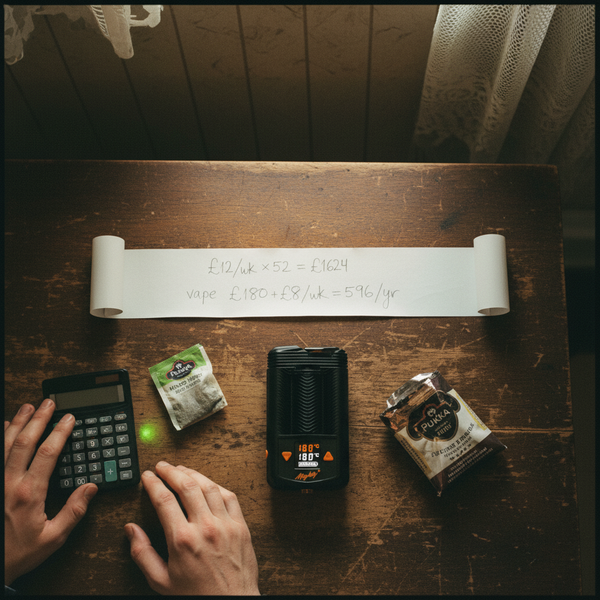
(If you want the full breakdown of what you're saving by switching, I covered the maths in The Maths of Vaping.)
The Temperature Truth: 185°C vs 315°C+
Here's where I get into the technical details, because the temperature difference is everything.
| Method | Temperature | What Happens | What You Taste |
|---|---|---|---|
| Combustion (smoking) | 315–480°C | Complete pyrolysis — plant burns, creating tar, benzene, formaldehyde, CO | Burnt, harsh, chemical, tar-coated tongue |
| Vaporisation (vaping) | 185–200°C | Selective extraction — cannabinoids/nicotine vaporise without combustion | Clean, actual plant flavour, terpenes preserved |
| Danger zone | Above 200°C | Benzene and carcinogens begin forming | Harsh, approaching combustion taste |
The Magic Number: 185–195°C
This is the "Goldilocks zone" for cannabis vaping (and similar for other herbs). At this temperature THC vaporises (activation 157°C), CBD vaporises (160–180°C), terpenes are preserved (most boil 130–200°C), no tar is created, no benzene is released (only forms above 200°C), no formaldehyde or naphthalene, and carbon monoxide is reduced by ~90% compared to smoking. For why 185°C is the sweet spot, see The Temperature Guide.
The Difference Is Massive
Controlled lab studies comparing cannabis smoke vs. vapour at 185°C found drastically lower concentrations of toxic and carcinogenic compounds in the vapour. Smoke contained benzene, naphthalene, toluene from combustion. Vapour achieved 95% cannabinoid availability without the nasties. It's not "a bit better." It's orders of magnitude cleaner.
Why This Matters for Taste
At 315°C+ combustion: all delicate flavour compounds (terpenes) are instantly destroyed; what you taste is tar, burnt plant, and chemical byproducts; your damaged taste buds can't detect the difference anyway. At 185°C vaporisation: terpenes are preserved and released as vapour; you taste actual plant flavour, aromatic compounds, strain character; your recovering taste buds can finally detect subtle differences.
When I smoked UK Cheese for most of my twenties, it tasted like… smoke. Maybe a bit "skunky" if I was lucky. When I vape UK Cheese now at 185°C with a palate that's been smoke-free for years, I taste peppery spice (β-caryophyllene at 130°C), earthy musk (myrcene at 167°C), funky-savoury cheese notes (humulene plus specific sulphur compounds), and fresh pine on the inhale (pinene at 155°C).
It's not the same plant. It's the same plant being treated with respect instead of being set on fire.
— Dennis M.
The Terpene Revelation: What You've Been Missing
This deserves its own section because it blew my mind when I finally understood it.
Terpenes are aromatic compounds in plants. They're what make lemons smell like lemons, pine trees smell like pine, and lavender smell like lavender. Cannabis has dozens of them, and they're what create the difference between strains.
The Problem with Combustion
Terpenes have relatively low boiling points (130–200°C). When you light them on fire at 315°C+, they don't "release" — they burn up before you can taste them. Research on smoke vs. vapour chemistry shows that combustion destroys around half of terpene content before it can be inhaled. You're literally burning away flavour before it reaches your mouth.
What Vaping Preserves
Here are the main terpenes in cannabis and their boiling points:
| Terpene | Boiling Point | Flavour Profile | Found In |
|---|---|---|---|
| Humulene | 107°C | Hoppy, earthy, bitter | Beer hops, cloves |
| Caryophyllene | 130°C | Spicy, peppery, warm | Black pepper, cloves |
| Pinene | 155°C | Pine, fresh, herbal | Pine trees, rosemary |
| Myrcene | 167°C | Earthy, musky, fruity | Mangoes, lemongrass |
| Limonene | 176°C | Citrus, sharp, zesty | Lemons, oranges |
| Linalool | 198°C | Floral, lavender, sweet | Lavender, mint |
When you vape at 185–190°C, you're hitting the sweet spot where lower-temp terpenes (humulene, caryophyllene) are fully released, mid-range terpenes (myrcene, limonene) are vaporising beautifully, higher-temp terpenes (linalool) are just starting to come through, and nothing is being destroyed by excessive heat. This is why vapers say things like "I can finally taste my weed." They're not exaggerating. They're experiencing flavour compounds that combustion was obliterating.
The Psychology: Why You Thought You Liked It
Here's the bit that made me feel like I'd been lied to for two decades. You didn't actually like the taste of cigarettes/spliffs. Your brain was lying to you.
Nicotine as a "Reinforcement Enhancer"
A 15-year study from the University of Pittsburgh discovered something fascinating about nicotine addiction: nicotine doesn't just give you a "hit" — it amplifies pleasure from your surroundings. You smoke a cigarette in a pleasant environment (pub, after dinner, with friends); nicotine increases dopamine in your brain's reward system; your brain associates the amplified pleasure with the cigarette itself; you unconsciously think "I love the taste of cigarettes." But you don't. You love the nicotine-enhanced version of your environment.
Researchers gave smokers cigarettes with nearly all nicotine removed. Smokers continued smoking them for a week or more before interest faded. People derive pleasure from the act of smoking when nicotine is enhancing their reward perception. Without nicotine, they realise cigarettes taste awful.
Why Relapse Tastes Awful (Then Doesn't)
Remember that birthday? That first inhale was disgusting because my taste buds were healed (could detect actual flavour), there was no nicotine in my system (no reward enhancement), and my brain accurately identified "this is poison" — because it is.
But here's the insidious bit: if I'd kept smoking that night, by the third cigarette it would have started tasting "normal" again. Not because the taste changed. Because nicotine would have re-hijacked my reward system.
Jake told me about his own relapse last year — same pattern: "The first one was disgusting and tasted chemical. After two or three, I was back in flavour country. I hated myself but I couldn't stop." Jake, incidentally, is the mate who later spent £299.99 on a TinyMight 2 thinking it would fix his relationship with cannabis. The TinyMight is a great vape. It's not, turns out, a personality.
Critical point: the taste is awful, but addiction can override disgust. This is why "just one" is so dangerous — not because it tastes good, but because nicotine will convince your brain it does. For what to do in that specific scenario, see The Slip-Up Protocol.
The Timeline: What to Expect (Including the Weird Bit)
Right, so you've quit smoking and switched to vaping. Here's the honest timeline of what happens to your palate.
Days 1–3: The Fog
Not much noticeable change yet. Mouth might taste stale (that's accumulated tar residue breaking down). Cravings will be high (unrelated to taste — that's nicotine withdrawal). For the hour-by-hour version, see The First Week Timeline.
Week 1: First Improvements
You'll notice you can smell things better (olfaction and taste are connected). Food starts tasting slightly more intense. You might cough more (your lungs are clearing out — this is good).
Week 2: The Tip of Your Tongue Comes Online
Tongue tip and lateral edges (high taste bud density areas) begin recovery. Citrus tastes sharper, salt is more pronounced, you'll notice texture differences in food. Tom told me he started noticing improvement around the two-week mark, but it took him about six weeks to really feel the dramatic changes.
Weeks 3–4: The Dysgeusia Phase Starts
Nobody warned me about this and it freaked me out. Dysgeusia = distorted taste perception during recovery. Everything tastes slightly "off" or metallic, persistent bad taste in your mouth (even with good hygiene), food you used to love tastes weird, your own breath tastes strange. This is normal. It's your taste buds recalibrating.
I had this for about five weeks. Bad breath, odd metallic taste, despite brushing twice a day and using mouthwash. Sarah was not thrilled. At one point she said "you smell like a battery and I want my husband back." My dentist said it's called dysgeusia and it should resolve within 8–12 weeks.
How to manage it: aggressive oral hygiene (but don't overdo it), stay hydrated (helps saliva production), avoid very sweet/salty foods (they can feel overwhelming), neutral foods (rice, mild vegetables) until it passes, and just wait it out — it's temporary.
Month 2: The Dramatic Shift
Around 4–8 weeks, something clicks. Taste and smell improvements become obvious. You start enjoying food again. If you're vaping cannabis, this is when strain differences become clear. Lung function improves by up to 30% between weeks 2–12 — the full breakdown is in Your Lungs After 30 Days Smoke-Free.
Dave described it perfectly: "I can taste coffee again. Actually taste it, not just 'hot brown liquid.'"
Month 3: The Relapse Test
This is when many people accidentally discover how bad cigarettes/spliffs taste now. Social situation, someone offers a smoke, you take one hit, "it tasted like an ashtray and I nearly threw up." This is your body being honest with you.
Months 4–6: Palate Fully Online
Most people report complete taste restoration by this point. Dysgeusia has resolved. Food becomes more enjoyable. If vaping cannabis, you can now identify strains by smell/taste. Tom's girlfriend made him a curry at the four-month mark — same recipe she'd made for years. He said he "about died at the heat" because he could suddenly taste ALL the spices, not just "hot." His spice tolerance had to completely reset because his chemosensory system wasn't numbed anymore.
Months 8–12: Final Recovery
Remember the dorsal loci (back of tongue)? Takes up to 8–12 months to reach non-smoker thresholds if you smoked heavily for years.
Dave needed the full 8 months for complete dorsal recovery after his 15-year habit, but even he said: "The recovery of my taste buds has been unreal. I can now taste onion. I used to think I hated onion. Turns out I just never tasted it properly."
The Verdict: Your Body Isn't Broken, It's Healing
Let me bring this back to that birthday in Manchester. When I gagged on that spliff, I felt embarrassed. Like I'd "gone soft" or become one of those preachy ex-smokers who can't handle reality. But that's not what happened.
What happened is: my taste buds spent months regenerating; my palate learned to taste actual plant compounds (terpenes) instead of combustion byproducts; my brain stopped lying to me about nicotine-enhanced "pleasure"; my body correctly identified that inhaling tar, benzene, formaldehyde, and over 400 volatile compounds is bad. I'm not overreacting. I'm reacting appropriately.
The Three Things I Wish Someone Had Told Me
1. The dysgeusia phase is real and temporary. If everything tastes weird/metallic for 4–8 weeks after you quit, that's not you being broken. That's your tongue recalibrating. Ride it out.
2. Your first cigarette/spliff after quitting will taste horrific. This is not a sign of weakness or being "too sensitive." This is your healed palate telling you the truth about what combustion tastes like. Listen to it.
3. The timeline varies (but it does get better). If you smoked heavily from your teens into your thirties, full recovery might take 8–12 months. If you were a lighter/younger smoker, it might be 2–4 months. But it happens. Your taste buds are resilient little bastards.
What This Means for Vaping
If you've switched to vaping — whether e-cigs or dry herb vapes — you're giving your palate the chance to heal. At 185–195°C vaping temperature: no tar coating your tongue, no benzene/formaldehyde/combustion VOCs, terpenes and flavours preserved instead of destroyed, and your taste buds can actually do their job.
This is why vapers become insufferable about flavour. It's not snobbery. They can finally taste what they're consuming. I'm now the sort of man who has opinions about olive oil. Sarah has made her peace with it. Mostly.
What Happens Next
Your taste buds are healing. Your palate is coming back online. You're going to taste things — good and bad — more intensely than you have in years.
Cigarettes will taste like burning chemicals (because they are). But good coffee? Proper spices? Fresh food? They're about to become revelations.
And if you're vaping cannabis, you're about to discover that Stardawg, Cheese, Haze, and Gelato don't all taste the same. They never did. You just couldn't taste the difference through the combustion.
Welcome to the other side. Your tongue thanks you. Your dentist thanks you. Your partner's olive-oil budget does not.
Three Vaporizers, Three Budgets, All Built for Flavour
Precise temperature control is the whole game when it comes to taste. All three of these will hold the 185–195°C sweet spot.
XMAX V3 Pro
£70.99
Surprisingly precise temp control for the money — happily holds 185–195°C, which is all your recovering palate actually needs.
Shop V3 Pro →Arizer Solo 3
£217.99
Glass airpath, pure flavour. If taste is your priority and you want every terpene to land cleanly, this is the one.
Shop Solo 3 →Mighty+
£255.99
What I use. Precise temp control, incredible extraction. The device that finally showed me what UK Cheese actually tastes like.
Shop Mighty+ →