Quit Combustion
Should You Actually Quit? An Honest Self-Assessment for UK Spliff Smokers
"Before this series asks you to do anything, I should ask whether you need to be doing it at all."

Not everyone reading this series should switch. If you smoke one spliff a month at parties and it fits your life, nine articles of quit protocol is massive overkill — and you should be told that rather than funnelled through a plan that doesn't apply to you. But if you're here because of the morning cough, the cost, the tobacco, the partner, the GP's last comment, the way it's started to feel less like a choice and more like a thing that's happening to you — the series is for you and you should read on.
This article is the self-assessment I wish someone had put in front of me in 2017. I've told three separate mates they didn't need to quit. Two of them still don't, and the third came back a year later on his own terms. That one worked.
The Conversation I Didn't See Coming
A few months ago I'm in the pub with Tom. Three pints into a Thursday at a place in Chorlton that still lets you sit near the window without asking if you've booked. He leans over and says: "I've been reading your stuff, Dennis. Thinking about switching."
I asked him how much he smokes. "One spliff on a Friday. Maybe another Saturday if we're at someone's place." He doesn't smoke tobacco any other time. No morning cigarettes. No daytime spliffs. No medical conditions. Enjoys it, feels no compulsion, has never tried to stop and had it not stop.
I took a sip and said: "Mate, I don't think you need to."
He looked at me like I'd told him the Pope wasn't Catholic. I write a whole series about quitting combustion. I've got articles about stag-do peer pressure and spreadsheets of pulmonary recovery data. I've got a drawer full of accessories Sarah has opinions about. And here I was telling a friend to keep doing the thing I spent the last eight years holding the line on.
But Tom's situation is genuinely different from where I was. I was on eighteen years of daily tobacco-heavy spliffs with a morning cough and a Ventolin on my nightstand. Tom's a weekend social smoker with clean lungs who honestly can't tell you how many spliffs he had last month because he's never needed to count. A nine-article quit protocol for someone like him would be like telling a bloke with three Friday pints that he needs AA. Wrong medicine, wrong patient.
A nine-article quit protocol for someone like him would be like telling a bloke with three Friday pints that he needs AA. Wrong medicine, wrong patient.
— Dennis M.
Sarah, when I told her about the conversation that night, said: "So you spent a whole evening convincing a man not to read your blog. That's brave marketing, Dennis." She was not, to be clear, wrong. But I think it's right.
This article exists because the rest of this series is about to ask things of you. It's about to ask you to change how you consume, spend money on a vaporizer, endure an uncomfortable week, and have awkward conversations with the people in your life. Before any of that, it should ask the question nobody else in this space seems to: should I actually be doing this?
What I Know About Who's Reading This
Quick reality check on how many UK spliff smokers this series applies to. The Crime Survey for England and Wales for the year ending March 2025 found that 6.5% of adults aged 16–59 used cannabis in the last twelve months. Of those past-year users, 10.4% used it every day. Multiply it out and about 0.7% of adults in England and Wales are daily cannabis users. That's a couple of hundred thousand people. A lot of them are smoking spliffs.
A moment on the source, because I enjoy this survey in the way other people enjoy cricket statistics. The Crime Survey for England and Wales is the big ONS household survey where a trained interviewer comes to your front door, sits down in your kitchen, and — after doing the burglary and domestic-violence modules — politely hands you a tablet on which you are invited to self-report, in private, which controlled substances you've taken in the past year. For a Home Office spreadsheet. I think about the response rate on the drugs module more than a well-adjusted person probably should. The 6.5% figure is therefore the headline number generated by the sort of person who tells strangers the truth about their drug use on a government tablet. There is a selection bias here, and it's pointing the only direction selection bias can point, which is down.
Inside that group, the picture's more interesting than a single number suggests. About a third of past-year users smoked more than once a month but weren't daily. Another big chunk are genuine occasional users — holidays, parties, maybe a bit of stress relief. The series I've written is built for the daily and near-daily crowd. It's not wrong for the occasional smoker, it's just overkill.
On the other end of the spectrum: as of early 2026, the UK medical cannabis scene has grown to an estimated 80,000–90,000 prescription patients, supported by roughly 160 prescribers across about 40 private clinics. I'm one of them. I know a lot of people who are newly one of them. The medical route has specific implications for the quit question — I'll come back to that in the checklist below.
The Five Questions I'd Ask Myself Before Committing
Sit with these honestly. The point isn't to talk yourself into quitting because you feel you should, or to talk yourself out of it because you don't want to. The point is to know where you actually are.
1. Do I know how much I smoke?
If the answer's a specific number — "three spliffs a day, give or take" — that's useful data. Probably means you're in the daily bracket where switching pays off biggest.
If the answer's "I don't know" or "it depends" — that's also useful data, in the opposite direction. Social and occasional smokers genuinely don't track because the volume's low enough that it doesn't matter. Daily smokers always know, even when we pretend we don't.
The dishonest third option is "a lot less than I actually do." I know the person I'm describing because I was that person in 2017. The honest answer lives about 30% above your instinctive one. Add 30%. I say this with the authority of a man whose 2017 self would have said "three a day" and whose receipts from the time suggest the actual number was closer to five.
2. Is tobacco the point?
This is the big one for UK readers. British spliffs are, on average, dominated by tobacco — research looking at the Global Drug Survey found that 77.2% of UK cannabis users mix with tobacco, compared with around 4.4% of US users in the same dataset (Hindocha et al., Frontiers in Psychiatry, 2016). Our relationship with cannabis is structurally different because of this. We aren't pure cannabis smokers — we're dual-substance smokers with the cannabis usually carrying the nicotine.
So the honest question is whether you're actually after the cannabis or whether you're after the nicotine and the cannabis is why you let yourself roll. If you also smoke tobacco-only cigarettes on weekdays, the answer's probably "nicotine's doing more of the work than I realise" — and you'd benefit from this series more than a pure-cannabis smoker would, because quitting spliffs will force you to deal with the nicotine thing properly. Gap two in this series — Quitting Tobacco Without Quitting Cannabis — is the article that exists specifically for us.
My mate Dave once spent two weeks in 2019 convinced cannabis withdrawal was trying to kill him. It was, in fact, tobacco. Blaming the wrong plant is the defining British first-quit mistake. I did it first; Dave did it with more commitment.
3. What are my mornings like?
If you cough in the mornings, if your chest feels tight on the stairs, if you've got a Ventolin in a drawer you've stopped thinking about, if you catch yourself breathing weirdly when you think nobody's listening — you already know the answer. The morning cough is the single clearest signal in this entire assessment. Your lungs are telling you something and you've learned to tune it out.
My GP, for what it's worth, did not say "stop smoking" when I finally went to see her in 2017. She said: "Your lungs are doing more than their share of the work." Which is the sort of diplomatic sentence that bounces around a man's head for six weeks before he does anything about it. If a medical professional has said something of that flavour to you — the elliptical British version of "mate" — that's the signal you should probably listen to.
If your mornings are clean — no cough, no tightness, full stamina — you're probably below the threshold where smoking is doing you meaningful physical harm you can feel. Not zero harm. But not the kind of harm this series is structured to address.
4. Is it still a choice?
There's a line I crossed somewhere around 2013 where cannabis stopped feeling like a thing I enjoyed and started feeling like a thing I did. I noticed it most on the days I didn't have any. The irritation. The difficulty settling. The way my evening plans quietly rearranged themselves around "can I get some on the way home."
Every regular user knows this line. It doesn't mean you were an addict. It means the habit had become automatic, which is a normal thing that happens when you do anything daily for years. The only useful response is honesty. Is this still a choice you're making, or has it quietly stopped being one? No judgement either way — but the answer matters, because if it's not a choice anymore, switching to a vape on its own isn't going to fix that. Vapes are just a different delivery method for the same plant.
5. Why now?
If your answer is "my partner's been on at me" — pause. The worst reason to quit is because someone else wants you to. These attempts collapse within weeks because there's no internal driver, only external pressure. You'll slip, you'll resent them, and the lapse will become a relapse because the commitment was never yours. I've read about 200 of these scenarios in my inbox over eight years and the pattern is depressingly consistent.
If your answer is "the money, the cough, the tobacco, the GP's last comment, I'm tired of waking up feeling like this, I can't run for the bus anymore" — that's real. Pain as motivation works. External pressure doesn't.
If your answer is "I'm not sure, I just feel like I should" — that's fine too. Vague motivation is still motivation. A lot of the successful quits I've watched started from a foggy sense that things had drifted, not from a dramatic inciting incident. If your body or your wallet or your life are quietly pointing you toward the door, that's enough reason to try.
Signals You Probably Should
This isn't a test score. It's a rough check. If several of these apply to you, switching is likely to improve your life substantially:
- Daily or near-daily use for more than two years.
- Morning cough, wheeze, chest tightness, or reduced stamina.
- Tobacco mixed into your spliffs (any amount — but especially if it's the bulk).
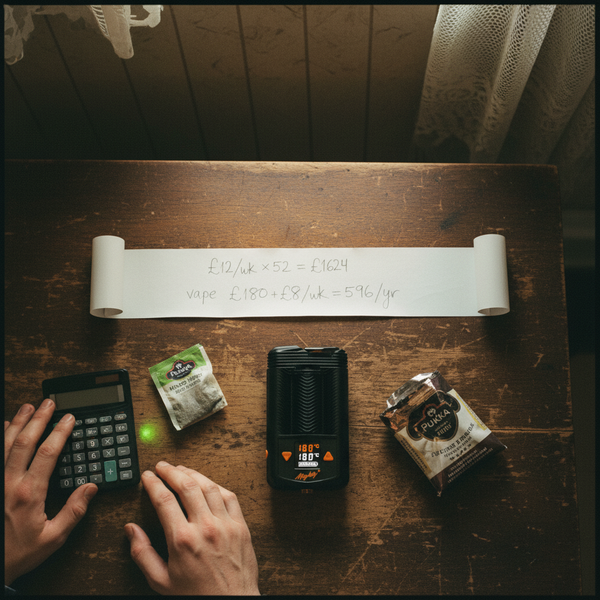
- Spending more than £80 a month on cannabis and related costs.
- Tolerance has climbed without the effect improving.
- Partner, parents, kids, or colleagues have started commenting on smell, cough, or mood.
- You've made private quiet resolutions to "cut back" that haven't held.
- You're on a UK medical cannabis prescription and smoking it actively defeats the medical point.
- You're in your twenties or thirties and expect to continue using cannabis for decades to come — the lung maths at forty years of daily combustion is genuinely not great.
On the medical-prescription point: I feel strongly about this. If you're paying £150–£200 a month for medical-grade flower and burning it with Amber Leaf, something's gone structurally wrong with your reasoning. I write as a man who spent his first six months as a prescription patient doing exactly this, and I do not recommend it.
Signals You Probably Shouldn't Bother
Equally, not everybody here needs this series:
- Weekend-only or social use, no daily habit.
- No tobacco in your spliffs (pure-flower rolling — rare in the UK but exists, and if that's you, you are a rare and sophisticated creature, and also slightly smug).
- No morning symptoms, stable lung function, can do stairs normally.
- Low total volume — sub-£30 a month on all cannabis-related costs combined.
- You've tried vaping already and genuinely didn't like it. The effect profile is different; not everyone prefers it, and the switch isn't compulsory.
- Your cannabis use isn't yet at a level where decades of it would predictably damage you.
- You're not asking the "should I cut back?" question yourself — someone else is asking it of you.
If several of those apply, you have your own permission to close this tab. The series will still be here if things change. Vaporizers aren't going anywhere.
What You'll Actually Give Up
The rest of this series is largely positive about switching. It should be — the benefits are real, measurable, and in my case have genuinely been life-changing. But I want to be honest about what you'll lose, because nobody else in the quit-spliffs space seems willing to acknowledge any of it.
The ritual. Rolling is meditative. The skinning-up process is the start of the evening for a lot of us. Vapes are faster, which sounds like a benefit until you realise you liked the slowness. The jar-and-grinder ritual is gone. Replaced, in my case, by a clean Solo 3 v2 and a little glass humidor. The new ritual is also fine. It's just not the one your hands learned.
The identity. For some of us, "I'm a smoker" is a piece of self-image — a counterculture tether, a shared thing with specific friends, a relic of the two decades this series keeps having to mention in the past tense. Switching to a vaporizer feels clinical by comparison. I love that now. I'd have hated it in 2016.
The social signalling. Passing a spliff in a circle is how a lot of UK friendships get structured. Vaporizers don't pass well. Session vapes take three minutes between hits. Portable vapes need to be reloaded. The circle dynamic breaks. This is covered in detail in You've Changed, Man, but it's worth flagging here: you'll need new social scripts, and the old ones won't come back.
The spontaneity. Rolling a spliff is low-friction. Using a vaporizer requires charging, cleaning, keeping the battery topped up, keeping herb in a humidity-controlled jar. It's not difficult, but it's more than reaching for a pouch and a grinder. ADHD crew, I'm looking at us — we'll have to work harder to make the switch stick. I speak as the man who once found his TinyMight 2 in the fridge and could not adequately explain to Sarah how it had got there.
The compatibility with drinking. I can tell you from testing: vapes at 2am after four pints go badly. I forget the temperature, I forget to reload, I over-draw, I get frustrated. Spliffs are very forgiving drunk. Vapes are not. You will, at times, miss the bulletproof simplicity of rolling.
None of these losses outweigh the gains for me now, eight years in. But they are real losses, and pretending they don't exist means you won't plan for them, and then they'll ambush you three months in and you'll wonder why you're miserable. Plan for them. Accept them. Move on.
A Question the Community Asks Itself a Lot
I spend a lot of time talking to other long-term cannabis users, and one question I see come up again and again — in my inbox, on UK cannabis forums, at meetups — is whether cannabis is actually the problem or whether you just think it is because you're supposed to.
The most useful reframe I've seen came from a long-term user writing into a UK forum: "Take 30 days off and see what your life is like without it. You can always make a decision after your break."
That's probably the smartest decision framework I've come across. It turns quitting into a testable question rather than an identity statement. Thirty days off tells you:
- Whether the thing you thought cannabis was giving you is actually something cannabis was giving you, or something you were attributing to it.
- Whether your sleep improves, stays the same, or gets worse.
- Whether you notice more focus, less focus, or neither.
- Whether you genuinely miss it or just miss the evenings not having a structured start.
- Whether you come back to it relieved, or notice you don't particularly want to.
If you do thirty days and come back thinking "that was pointless, I'm fine on it" — then you probably didn't need to quit. You might still want to switch from spliffs to a vape purely for the tobacco/lung reasons, but the existential "should I quit cannabis?" question has its own honest answer.
If you do thirty days and come back thinking "I feel better, this was worth examining" — then the series is for you and you know you're not just trying to please someone else.
The Permission Slip
If you've read this far and decided you don't need to quit — genuinely, not just as avoidance — fair play. Close the tab. Enjoy the spliff. You're an adult, this is a free country as far as it concerns you, and the eight articles that follow aren't mandatory reading. You have, for what it's worth, my permission to consider yourself in the Tom category. Most people reading this blog are not Tom. But Tom is welcome here, and so are you.
If you've read this far and decided you do — welcome to the series. The next article is The Maths of Vaping, which is the financial case, and will answer the "will this cost me more than it saves me?" question with receipts. After that, Quitting Tobacco Without Quitting Cannabis handles the specific UK problem of what to do about the nicotine, which is the thing most people get wrong. Then The Home Front helps you prepare the conversations with whoever you live with.
Then the transition week itself. Then the physiology. Then the social friction. Then the protocol for when you slip.
Nine articles. Done in order, they are a full plan. You don't have to commit today. But knowing the plan exists, and that your decision to begin it is a real decision and not just a vague intention — that's where it starts.
And when you do commit, and the first week feels like somebody is sandpapering the inside of your skull, I'd like you to remember the line I learned from Dave in 2018 and have been passing on to new readers ever since: blame the right plant. Nine times out of ten in week one, it's the tobacco kicking you. The cannabis, you're still using. The cannabis is fine.
Blame the right plant. Nine times out of ten in week one, it's the tobacco kicking you. The cannabis is fine.
— Dennis M., quoting Dave
Three Vaporizers, Three Budgets, No Pressure
You don't need to buy anything to read the rest of this series. But if you've finished the self-assessment and you're committed, here's where I'd start.
XMAX V3 Pro
£70.99
Swappable batteries, honest vapour, no nonsense. Where my mate Jake landed after his expensive detour through a TinyMight 2.
Shop V3 Pro →Arizer Solo 3
£217.99
Glass airpath, pure flavour, well-built. The "new ritual" I mentioned earlier — this is the one my hands learned next.
Shop Solo 3 →Mighty+
£255.99
What I use. Built like a tank, massive bowl, incredible vapour quality. The reason I eventually stopped buying lighters.
Shop Mighty+ →