XMAX Starry 4 Review: The Filter Coffee Machine of Dry Herb Vaporisers
"Filter coffee from a decent machine — not artisan, not instant, just reliably okay every morning."

The XMAX Starry 4 is filter coffee from a decent machine — not artisan, not instant, just reliably okay every morning. Pure conduction, session-style, with a removable 18650 so it will never brick on you. It runs hot in the hand, the vapour blends where better devices layer, and the V3 Pro sits three quid away doing it in convection. But it is honestly priced, genuinely durable, and the only vape I own that survived six months in a drawer and still worked on the first press.
- Score: 7.2/10
- Best for: Conduction enthusiasts who specifically want that slow-joint, stonier body buzz over cleaner convection effects, backup buyers who need a drawer-dweller that sits untouched for months and still works, 18650 fans who refuse to be held hostage by a sealed cell, budget buyers who want "good enough" and understand exactly what they are trading off, evening session users who want to be properly sedated before bed
- Skip if: Flavour chasers — conduction cooking blends terpenes rather than separating them, cloud chasers — the V3 Pro's convection heater rips harder with less effort, people sensitive to device heat — the zinc alloy shell gets genuinely warm by minute four, anyone who can stretch £12 further, where the V4 Pro is waiting, buyers who want a single do-everything vape rather than a specialist
- Price: £76.99
As a backup, a conduction-preference choice, or a first budget vape you will not resent? It earns its money.
Pros
- Removable 18650 battery — swap a £6 cell in 30 seconds; the single feature that gives the Starry 4 real longevity over sealed-battery competitors
- Airflow adjustment slider — new for this generation; open for bigger clouds, closed for tighter, brighter draws, and there is a genuine difference between the two ends
- Conduction character delivers a stonier body buzz — the slow-cooking extraction produces heavier, more sedative effects than convection devices from the same material, which some people specifically want
- Three session timers (4 / 6 / 10 minutes) — real flexibility for quick hits, normal sessions and sharing; hold power plus up to cycle
- Drawer reliability — six months in my office drawer, no charge, no firmware, no app; pulled it out half-charged and it worked on the first press
Cons
- The zinc alloy shell gets genuinely warm — by minute four at 190°C and up you are rotating your grip to avoid the hottest spots; not dangerous, but present and annoying
- Vapour blends rather than separates — the always-hot oven homogenises a complex terpene profile into one warm note by the third draw
- The V3 Pro is three quid away — £3.00 more buys you a convection heater, on-demand mode and better flavour, and that comparison follows this device everywhere
- Mouthpiece components are budget-grade plastic — the magnetic closure is good, but the housing around the zirconia cooling chamber feels like it will tire with repeated ISO cleaning
- Conduction means the oven is always cooking — the last two minutes of every session taste more roasted than vaped, whether you are drawing or not
The Hook: Filter Coffee Every Morning
Filter coffee from a decent machine.
Not artisan. Not instant. Not a £1,200 espresso setup with pressure gauges and steam wands. Just a £70-odd filter machine that makes drinkable coffee every morning for three years, then you buy another one.
Is it as good as the indie café down the road? No. But it's there. Every morning. Consistent. Boring. Good enough.
The XMAX Starry 4 is that coffee machine.
It's not a Mighty+. It's not a V3 Pro. It isn't trying to compete with convection extraction at all. It's a pure conduction oven that slowly cooks your flower like a frying pan, releases cannabinoids in waves rather than bursts, and if you treat it like a slow joint instead of expecting precision vapour, it quietly gets you stoned before bed without drama.
I forgot I owned this vape. Not "forgot to use it" — actually forgot it existed. Bought it as a backup, threw it in a drawer, used my Mighty+ and V3 Pro for six months. Then one evening the Venty wanted a firmware update and I couldn't be arsed to wait.
Opened the drawer. There it was. Still half-charged. Still worked.
Sarah saw me using it and said: "Is that the emergency one from the drawer?"
"Yeah."
"The one you forgot about?"
"Yep."
"And it still works."
"Yep."
"Meanwhile your £304.99 Venty needs a software update."
She's right. The Starry 4 is boring. And sometimes boring is the whole point.
We stock the Starry 4 at HerbVape.co.uk — details and pricing below.
Vapour Quality 7.0/10
Here is the honest position of conduction in 2026: it is no longer the default at this price. The V3 Pro at £79.99 runs a 100% convection heater that separates flavours the Starry 4 blends together. The Starry 4 is pure conduction — the ceramic oven walls heat, extraction begins the moment they do, and your material cooks whether you are drawing or not. That is not inherently bad. It is a characteristic with a cost, and the cost is resolution.
The conduction character: The first two pulls of any bowl are genuinely good — recognisable strain flavour, decent density, no scorch. By pull three you are tasting the oven as much as the flower. The sustained heat also does something worth having: more thermal conversion, a heavier body-load, and a session that lands like a slow joint rather than a sharp hit. If your evening ends on the sofa rather than at a desk, that is a feature.
The airflow slider helps, within limits. Closed, the draw tightens and the bright end of a strain holds roughly one draw longer than it otherwise would. Open, you get more visible cloud and less definition. Halfway is where I leave it for most sessions. It is a flavour-versus-cloud trade, not a change to how the device heats — nothing about the slider makes this anything other than a conduction oven.
What earns the 7.0: it does the fundamentals properly. Even extraction, no hot spots, no scorched edges, ABV that comes out an even brown, and a Wedding Cake–class dessert strain rendered genuinely well. What keeps it off an 8 is resolution — complex profiles arrive as one warm note rather than four separable ones — plus shell heat that makes the back half of a long session less comfortable than it should be. Three pounds up the range, the V3 Pro does the delicate half of the job better. It does not do the drawer-survival half at all differently, mind, because it is the same battery architecture.
The Strain Test
Filter coffee gets judged against the same beans as the fancy machines — that's the whole point of the house benchmark: fixed flower, fixed grinder, fixed weights, and only the machine changes. The Starry 4's question is a blunt one: can a hot oven do anything more than make everything taste warm and brown? Oven brushed and mouthpiece stripped between the two, as always.
Jack Herer — Sativa
The Flower: Same jar as every other device on this site. Haze × (Northern Lights #5 × Shiva Skunk), around 20% THC, terpinolene-led with caryophyllene and pinene behind it. Pale, spindly, hairy stuff that looks less impressive than it smokes — crack the jar and it's pine needles and lemon peel first, dry green herbs underneath, black pepper right at the back. Old-school in the way that means "aromatic", not "weak". It's the strain that shows you up: the top notes are fragile, and if a vaporiser can't hold them you find out in the first three seconds.
The Pack: 0.22g, medium grind, firm and even into the ceramic oven — a loose pack in a conduction chamber channels and scorches the edges, and pack pressure matters more here than the temperature you pick. Airflow slider closed. Six-minute timer.
Low Temp (180°C): Pine needles on draw one, properly bright, with lemon peel sitting just behind it and dry green herb underneath. Draw two holds it. Draw three is where the oven starts winning — the citrus lift thins, the pine goes from fresh to warm, and by draw four you are into green herb with the top taken off. Four draws at this stage and two of them were the real thing. That is the class's honest tally.
Mid Temp (190°C): Black pepper turns up immediately and it is the most legible thing in the bowl for the rest of the session. Behind it, a woody haze and dry earth, all of it perfectly fine and none of it fragile. This is the durable heart of Jack and conduction handles durable heart material without complaint. Four draws, each denser than the last. The shell is warm enough by the end of this stage that I swapped hands without thinking about it.
High Temp (205°C): Earth and leather, a savoury roast creeping up behind, then toasted herb and flatness. Three draws and the bowl is spent, ABV an even mid-brown with no black edges.
The Verdict: Two good draws out of eleven is the tally, and it is not a scandal — it is what a hot oven does to a fragile strain, stated plainly. The slider is worth something here: closed, it bought me most of a third draw of brightness before the homogenising started, and that is both its genuine contribution and its ceiling. Nobody writes home about the second cup of filter coffee, and nobody pours it away either. The Starry 4 renders Jack Herer acceptably for the first third and competently for the rest, which is exactly what a 7.0 vapour score sounds like. It is not a Jack machine.
Wedding Cake — Indica-Leaning Hybrid
The Flower: Same jar as every other device on this site. Triangle Kush × Animal Mints, via Triangle Mints #23 — around 24% THC, caryophyllene first, then limonene and myrcene. Dense, squat, greasy nuggets that leave your fingers tacky and your grinder needing a wash. Nose is vanilla and cream over sweet raw dough, with a peppery earth underneath and a cherry-berry edge that turns up on the exhale more than the sniff. Modern dessert genetics doing exactly what it says on the tin. Where Jack exposes a device, this one flatters it.
The Pack: 0.22g again, same medium grind, same firm tamp — the greasy stuff needs the pressure less but the ceramic bowl still wants a full load. Slider at halfway this time, because density is the point with this strain rather than definition.
Low Temp (180°C): Vanilla and sweet cream on draw one, thicker than the Jack ever managed, with sweet raw dough arriving on draw two and a cherry edge on the exhale. Four draws, all of them warm and comfortable, none of them harsh. The zirconia cooling chamber is small but it does enough that nothing arrives hot at this temperature.
Mid Temp (190°C): This is the device's best stretch. Butter shows up alongside the dough, the body thickens noticeably, and black pepper starts emerging underneath around draw three. Richness is the prize here and the oven hands it over generously. The catch is that vanilla, butter and dough are arriving as one thing rather than three — I can taste that all of them are present, I could not separate them for you blind. Four draws.
High Temp (205°C): Toasted and nutty, sugar caramelising toward a burnt edge, pepper turning pungent. Three draws and it is done; the shell is at its warmest and the session timer runs out at almost exactly the right moment.
The Verdict: This is the cup you actually drink. Dessert genetics and hot walls want the same things, and by draw five the Starry 4 is producing something warm, thick and comfortably rich that no glass-path device at this money would give you. Put the two strains side by side at 205°C and they are still recognisably different plants — Jack in leather and roast, this one in caramelised sugar — so the device is not converging everything into brown, which was the fear. What it will not do is resolve. A conduction oven blends where a convection heater layers, and the Starry 4 is honest about being the blender. Richness is what you are buying, and it is worth the £76.99 on its own terms.
Design & Build 6.5/10
The Starry 4 feels like a £76.99 vape. Zinc alloy body with the energy of a petrol station torch — looks solid enough in the shop, works fine for ages, and then one day you notice the button is getting wobbly and remember you paid for exactly what you got.
The heat problem: the zinc alloy shell absorbs heat from the conduction oven, and it is the most obvious compromise in the device. By minute four at 190°C and above you are rotating your grip to avoid the warmest spots. It is not dangerous. It is noticeable, every session, and it is the reason this scores 6.5 and not 7.5.
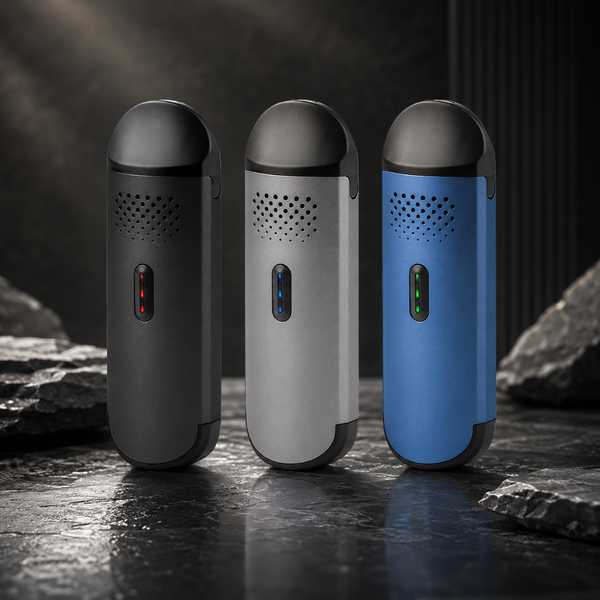
Materials breakdown: zinc alloy shell, substantial but heat-conductive. Ceramic oven bowl. Plastic mouthpiece with a magnetic closure and a zirconia cooling chamber inside it — the magnetic snap is satisfying and it stays shut in a pocket. The battery door is far sturdier than the Starry 3's; XMAX clearly listened to the complaints. The OLED screen is small but readable, showing temperature and battery level.
The forgotten-drawer durability: the Starry 4's quiet strength is that it simply survives. Six months in an office drawer, no maintenance, no charging, pulled out half-charged and working immediately. No firmware to update, no app to reconnect, no Bluetooth to re-pair. Simple hardware doing simple things, and that simplicity buys a kind of reliability that cleverer devices can't match. At ~138g and ~114 × 38 × 22mm it is a chunky little brick, and chunky little bricks tend to still be there in year three.
Battery & Charging 8.0/10
The removable 18650 is the Starry 4's best feature, and it is the same architecture that earns the V3 Pro, the V4 Pro and the Air SE their marks in this category. Immortal battery life for about six quid a swap.
Real-world bowls per charge: 5–7 bowls at 185–195°C with six-minute sessions. Cell capacity varies by SKU — the Topgreen retail model ships a 2550mAh cell, the POTV version a 3200mAh one, and TopGreen publishes no official figure for either. The bigger cell adds roughly one to two extra bowls per charge and costs a few pounds more if you can find it.
The removable cell advantage: when the battery degrades after a year or two, and lithium cells always do, you buy a Samsung 25R or a Sony VTC6 for £6–8, swap it in 30 seconds, and you are back to full capacity. Compare that to a sealed Crafty+ that becomes a £186.99 paperweight when its cell gives up, or a V3 Nano that needs replacing outright. The removable 18650 is the difference between a two-year device and a five-year-plus one, and it is the single biggest reason the Starry 4 is worth owning at all.
Charging: USB-C, quoted at around 90 minutes, 2–2.5 hours in my testing with a decent 2A charger. Pass-through works but performance is noticeably weaker while plugged in. For heavy users an external 18650 charger is the better buy — it charges spare cells while you use the device and takes the USB-C port out of the failure chain entirely.
Ease of Use 7.0/10
The Starry 4 is simple in concept with a small technique tax that the V3 Pro largely avoids.
The operation: five clicks to power on. Up and down buttons set the temperature. Wait 25–35 seconds for the vibration. Draw slowly and steadily. The session auto-shuts after your chosen timer — 4, 6 or 10 minutes, cycled by holding power plus up. It is a straightforward interface on a small OLED screen and there is nothing to learn beyond it.
The airflow slider: new for this generation and genuinely useful. Open for unrestricted draws and bigger clouds. Closed for tighter resistance and a brighter first third. Halfway is my default, and unlike a lot of budget-vape "features" this one does something you can taste.
The learning curve: the Starry 4 wants to be sipped like a joint, not ripped like a bong. Slow draws let the vapour cool on its way through the zirconia chamber; fast pulls give you hot, harsh vapour and nothing else. Pack pressure matters too — firm and even, or the oven channels. And there is the ongoing heat-management tax: after four minutes you are actively rotating your grip, which is attention that easier devices don't ask for. None of this is difficult. It is just not free.
Cleaning & Maintenance 6.5/10
The timeline: after 5–10 bowls, the screen has residue and the vapour path has a thin film, but the draw is still fine. After 20 bowls, the screen is clogged, the mouthpiece has visible buildup, and draw resistance is up enough to notice. That is your cue.
The process: pull the magnetic mouthpiece off. Pop the screen out with a paperclip. Disassemble the mouthpiece into its magnetic cap, zirconia cooling chamber and silicone seal. Drop the screen, cooling chamber and silicone into ISO for twenty minutes. Wipe the ceramic oven with an ISO-dampened cotton bud. Rinse, dry, reassemble. Ten minutes of active work plus twenty of soaking.
The budget fragility: the plastic mouthpiece housing feels like it will tire with repeated ISO exposure. The zirconia chamber itself is durable; the plastic around it is budget-grade. Be gentle on disassembly — forcing anything is a recipe for cracked parts that cost £10–15 to replace.
Conduction cleaning reality: conduction ovens get dirtier faster than convection chambers because the material sits in permanent contact with hot walls. You will be cleaning the Starry 4 more often than a V3 Pro to hold the same draw resistance and flavour. That is not a fault, it is arithmetic, and it is why this category sits at 6.5 while the rest of the device has climbed.
Portability 7.5/10
The Starry 4 is pocket-friendly but not pocket-invisible. At ~114 × 38 × 22mm and ~138g it is wider than most of its competition. Front pocket is fine; back pocket and you will feel it sitting there.
It looks like a vape and it produces more residual smell than a convection device, because the oven is always cooking whether you are drawing or not. Where it fits naturally is outdoors — pub garden, park bench, walking the long way home — because sessions are four to ten minutes and the conduction buzz mimics the ritual of a slow smoke. It is not a stealth device. The shell is warm for a couple of minutes after a session, and you feel the commitment of having started one. What earns the 7.5 is that a spare 18650 in the other pocket makes it effectively unlimited away from a plug, which is more than most pocket vapes at this money can say.
How I Actually Use This
The Starry 4 lives in my office desk drawer. That is not a metaphor — it is literally where it stays, ninety per cent of the time.
My Starry 4 session is almost always identical: evening, on the sofa, 190°C, six-minute timer, slider at halfway. I load 0.2g of something indica-leaning, sip it slowly, and let the conduction buzz settle in. It is a bedtime ritual device. The heavier, more sedative effects of a slow-cooked bowl suit the end of the day better than any other part of it, and I have never once wanted this device at nine in the morning.
I reach for the V3 Pro first, the Mighty+ second, and the Starry 4 third — when the first two are elsewhere. It is the backup's backup, and not every device needs to be a first choice to be worth owning. The forgotten-drawer test is this thing's real proof of concept: six months untouched, pulled out, still working. No sealed cell dying from dormancy. No firmware waiting to be applied. Just a conduction oven, a battery and a button.
Medical Use Notes
I'm not a doctor. I'm a bloke with chronic pain and ADHD who's been using cannabis medicinally for years now. This is my experience, not medical advice. If you're considering medical cannabis, talk to a prescribing clinic — I've linked some resources at the bottom of this review.
The Starry 4's conduction character cuts both ways medically. The heavier, more sedative effect of sustained-heat extraction has been useful for me for evening pain management and getting to sleep — if you need body-load at night rather than clarity in the day, this heating type is on your side rather than against you.
For pain management: the 6 and 10-minute session timers give you natural dosing boundaries, which matters more than it sounds when you are tired and losing track. The adjustable temperature gives some control over intensity. And the removable 18650 means the device is available when you need it — no sealed-battery anxiety during a flare, and a spare cell costs less than a takeaway.
For ADHD management: wrong tool. The sedative character works directly against daytime focus, and the six-minute minimum session is a blunt instrument for microdosing. I use convection devices with on-demand heating for that, and I would recommend anyone in the same position does the same.
Value for Money 7.0/10
Price: £76.99
This is where the Starry 4 has to live with an uncomfortable neighbour: the V3 Pro exists, and it costs £3.00 more.
The filter coffee economics: a £70-odd filter machine makes decent coffee for three years and nobody regrets buying one. But if the shop told you that for three quid more you could have a machine that brewed better coffee, faster, with a keep-warm plate — you would find the three quid. That is the V3 Pro against the Starry 4 in one sentence, and it is the honest headline of this review.
It is not, however, the whole story, and a 6.0 for value would have been me confusing "has a better sibling" with "is bad".
What £76.99 buys you: a pure conduction session vape with a removable 18650, a working airflow slider, three session timers, USB-C, and vapour that is genuinely good with dessert genetics. Drawer reliability that far pricier devices cannot match. A five-year device rather than a two-year one, because the only part that wears out is the part you can replace for six pounds.
What the extra £3.00 buys instead (V3 Pro): a 100% convection heater, better flavour separation, on-demand mode for microdosing, and denser clouds. Same removable 18650, same USB-C. It is the better vaporiser and I am not going to pretend otherwise.
The case for the Starry 4: you specifically prefer conduction's heavier buzz. You want the airflow slider, which the V3 Pro doesn't have. You want the 10-minute timer for sharing. You already own a V3 Pro and want a backup with a different character. Or you found it on offer, in which case take it.
The case against: for most people asking "which one budget vape should I buy", the answer is still the V3 Pro, and it costs almost nothing more to follow that advice. The Starry 4 is fairly priced for what it is. It just happens to stand next to something slightly better wearing almost the same price tag.
The Verdict (The Bookend)
Seven months in, and the Starry 4 still lives in my desk drawer. That isn't a failure. That is precisely its job.
I don't reach for it first. I don't think about it when I'm planning an evening. But when the Venty wants a firmware update, when the Crafty+ is flat, when the V3 Pro is at a mate's house — I open the drawer and it's there. Half-charged. Ready. No questions asked.
The filter coffee machine doesn't need to be the best coffee machine. It needs to make drinkable coffee every morning without requiring your attention. The Starry 4 does that for vaping: it shows up, does the job, and doesn't ask for gratitude.
Where does 7.2 actually put it? Three tenths under the V3 Nano at 7.5 — a device costing half as much that does a great deal less — the same three tenths under the PAX Mini 2 at 7.5, and eight tenths behind the V3 Pro it keeps getting measured against. That gap is real and I have spent this whole review being honest about it. But eight tenths is a preference, not a warning, and the three pounds between them is not the gulf the numbers make it sound like.
So: if you are buying one budget vape and you have no strong feelings about heating type, buy the V3 Pro. If you want conduction's heavier evening buzz, or the airflow slider, or a backup that will still be working in year five on its second six-pound cell, the Starry 4 is a fair purchase at a fair price. It doesn't top the list. It absolutely earns its place on it.
7.2/10 — the drawer-dweller. Always there. Always fine. Better than you'd expect for the money, and honest about what it isn't.
Score Breakdown
| Category | Score | One-Line Summary |
|---|---|---|
| Vapour Quality | 7.0/10 | Even, honest extraction that blends rather than separates; excellent with dessert strains, ordinary with fragile ones |
| Design & Build | 6.5/10 | Petrol-station-torch solidity; the zinc shell gets warm and the mouthpiece plastics are budget-grade |
| Battery & Charging | 8.0/10 | Removable 18650, 5–7 bowls, £6 to renew — the same immortal-battery advantage as the rest of the XMAX line |
| Ease of Use | 7.0/10 | Simple interface and a useful slider, with a slow-draw technique and a heat-management tax attached |
| Cleaning & Maintenance | 6.5/10 | Straightforward twenty-minute job, but conduction ovens dirty faster and the plastics want handling gently |
| Portability | 7.5/10 | Front-pocket friendly rather than invisible; a spare cell makes it unlimited away from a plug |
| Value for Money | 7.0/10 | Fairly priced on its own terms, permanently overshadowed by a sibling £3.00 up the range |
| Overall | 7.2/10 | The reliable backup — boring, functional, and still working when the clever devices are asking for updates |
Category average is 7.1. The overall sits above it because the removable cell and the drawer-reliability are worth more in year three than they look on a spec sheet.
Vs the Competition
The Starry 4's biggest competition is inside XMAX's own catalogue, and one Arizer that has quietly become the cheaper option.
The comparison that follows this device around. £3.00 more buys a 100% convection heater, on-demand mode and better flavour separation, on the same removable 18650 platform. The Starry 4 answers with the airflow slider, a 10-minute timer and the heavier conduction body-load — real advantages for a specific person, and that person is not most people. If you are choosing your first budget vape and have no strong feelings about heating type, buy the V3 Pro.
| Category | Starry 4 | [XMAX V3 Pro] |
|---|---|---|
| Price | £76.99 | £79.99 |
| Heat-up | 25–35s | ~30s |
| Vapour Quality | 7.0/10 | 8.0/10 |
| Overall | 7.2/10 | 8.0/10 |
The in-family upgrade, and £12.01 more. The V4 Pro is pure convection with brighter flavour, an eleven-second heat-up, its own adjustable airflow and a glass mouthpiece in the box — the enthusiast sibling that makes the Starry 4 look like exactly what it is: the boring reliable conduction backup. The Starry 4 holds up on chamber size, on session-timer flexibility, and on familiarity for anyone coming to vaping from conduction herb pipes. If you are choosing new, save the extra twelve quid and buy the V4 Pro. If you already own one and want a cheap drawer-dweller alongside it, the Starry 4 still does that job.
| Category | Starry 4 | [XMAX V4 Pro] |
|---|---|---|
| Price | £76.99 | £89.00 |
| Heat-up | 25–35s | ~11s |
| Vapour Quality | 7.0/10 | 8.5/10 |
| Overall | 7.2/10 | 8.3/10 |
This one has flipped, and it is worth saying out loud: the Air SE is now the cheaper device by £4.00, not the budget alternative to the Starry 4. It delivers cleaner glass-path flavour, gets 5–6 bowls from its own removable 18650, and takes 60–90 seconds to get there. Its weakness is the glass stems, which break if you look at them unkindly, and its preset temperature steps are coarse. The Starry 4 is the more robust object with the more flexible interface. The Air SE is the better-tasting one, for less money.
| Category | Starry 4 | [Arizer Air SE] |
|---|---|---|
| Price | £76.99 | £72.99 |
| Heat-up | 25–35s | 60–90s |
| Vapour Quality | 7.0/10 | 8.5/10 |
| Overall | 7.2/10 | 7.9/10 |
A different category rather than a rival. The Nano is £37.99 cheaper and gives up temperature control, battery swappability and session length to be genuinely tiny. If pocket disappearance is the requirement, it wins by default. If you want to actually control a session, the Starry 4 is a different class of tool and the extra money is doing obvious work.
| Category | Starry 4 | [XMAX V3 Nano] |
|---|---|---|
| Price | £76.99 | £39.00 |
| Heat-up | 25–35s | not published |
| Vapour Quality | 7.0/10 | — |
| Overall | 7.2/10 | 7.5/10 |
| Category | Starry 4 | Comparison Table | V4 Pro | Air SE | V3 Nano |
|---|---|---|---|---|---|
| Price | £76.99 | £79.99 | £89.00 | £72.99 | £39.00 |
| Heat-up | 25–35s | ~30s | ~11s | 60–90s | not published |
| Battery Life | 5–7 bowls (18650 removable) | 6–8 bowls (18650 removable) | 6–8 bowls (18650 removable) | 5–6 bowls (18650 removable) | sealed |
| Vapour Quality | 7.0/10 | 8.0/10 | 8.5/10 | 8.5/10 | — |
| Ease of Use | 7.0/10 | 7.5/10 | 7.0/10 | 9.0/10 | — |
| Cleaning | 6.5/10 | 7.0/10 | 7.5/10 | 9.0/10 | — |
| Portability | 7.5/10 | 8.5/10 | 8.0/10 | 8.5/10 | — |
| Overall | 7.2/10 | 8.0/10 | 8.3/10 | 7.9/10 | 7.5/10 |
| Heating | Pure conduction | 100% convection | Pure convection | Convection (glass path) | not published |
| Temp Control | Full, 100–240°C (unofficial) | Full, 100–220°C | Full, 100–220°C | Preset steps | Fixed |
| Airflow Slider | Yes | No | Yes | No | No |
| Best For | Conduction backup | Budget all-rounder | Convection enthusiast | Glass-path flavour | Pocket stealth |
FAQ
Ready to bring the XMAX Starry 4 home?
The boring one that keeps working — in stock and shipped from the UK.
£76.99
Shop XMAX Starry 4 →Worth Grabbing With It
- XMAX Starry V3 Mouthpiece Screen – XMAX vaporiser accessory, and the part you'll replace most often
- X-MAX Starry Bong Adapter – X-Max vaporiser accessory for water filtration
- HerbVape Universal Cleaning Kit – Universal vaporiser cleaning kit
- HerbVape 4-Piece Grinder – HerbVape vaporiser-optimised grinder