Editorial · Fact-Checked
The Bioavailability of Vaporising vs Smoking
Roughly three-quarters of the cannabinoids in a joint never reach your bloodstream. Vaporising changes the equation.
Reviewed by [Clinician Name, Credentials] — [Date]
Bioavailability is the fraction of a substance that reaches systemic circulation in active form. Smoked cannabis is 25–30% bioavailable — the rest is lost to combustion, sidestream drift, and incomplete absorption. Vaporisation lifts the figure substantially (estimates vary by device and session length but consistently land 2–3× higher), which is why 40–60% less flower produces the same effect. The pharmacokinetic curves are similar; the efficiency is not.
Less flower, same effect. The bioavailability gap is why vaporising pays for itself on material savings alone.
When cannabis is smoked in a joint, roughly three-quarters of the cannabinoids never reach the bloodstream. They are destroyed by combustion temperatures exceeding 400°C, lost to sidestream smoke drifting into the air between puffs, or trapped in the paper and filter. What remains — the 25–30% that actually makes it into the lungs — represents a remarkably inefficient delivery system for a substance that many users are paying a significant amount of money for.
Vaporisation changes that equation. By heating cannabis below the point of combustion, a vaporiser eliminates both pyrolytic destruction and sidestream loss, delivering a substantially higher proportion of the available cannabinoids to the lungs. The practical consequence is that less material produces the same or greater effect — a fact with implications for both medical dosing and everyday consumption costs.
This article examines the pharmacokinetic evidence for that claim, explains what bioavailability actually means, and translates the clinical data into practical terms. For a personal perspective on the financial maths, see Dennis's The Maths of Vaping.
What Bioavailability Means
Bioavailability is the fraction of an administered substance that reaches systemic circulation — the bloodstream — in an unaltered, pharmacologically active form.[1] It is expressed as a percentage from 0% (none reaches the blood) to 100% (all of it does). Intravenous injection is the reference standard at 100%, because the substance bypasses all absorption barriers.
Every other route of administration faces losses. Oral consumption loses cannabinoids to stomach acid degradation and first-pass metabolism in the liver. Smoking loses them to combustion, sidestream drift, and incomplete absorption. Vaporisation faces its own losses — some vapour is exhaled without being absorbed, and not all cannabinoids are released from the plant material — but the losses are substantially smaller than those associated with smoking.
The reason inhalation works well for cannabinoids is anatomical. The lungs present an enormous surface area — roughly the size of a tennis court — lined with thin-walled alveoli that allow rapid gas exchange.[1] Inhaled cannabinoids cross the alveolar membrane directly into the pulmonary bloodstream, bypassing the liver entirely. This produces peak plasma concentrations within minutes, psychoactive onset within seconds to minutes, and a peak effect at approximately 15–30 minutes.[2, 3]
Where Cannabinoids Go When Cannabis Is Smoked
The losses inherent in smoking cannabis are substantial and well-documented. Understanding where the cannabinoids actually go explains why the bioavailability of smoked cannabis is as low as it is.
Sidestream smoke accounts for the single largest loss. Between puffs — while the joint is simply burning — roughly 40–50% of the total cannabinoid content drifts into the surrounding air as sidestream smoke.[4] Some estimates suggest that up to 80% of the total smoke produced by a joint enters the atmosphere rather than the lungs.[4] This is not inhaled; it is wasted.
Pyrolytic destruction accounts for the second-largest loss. Combustion temperatures exceed 400°C — well above the boiling points of THC, CBD, and other cannabinoids — and approximately 23–30% of the cannabinoid content is simply destroyed by heat before it can be inhaled.[4]
Mainstream smoke delivery — the smoke that is actually drawn into the lungs — represents roughly 20–37% of the total cannabinoid content.[4] But not all of this is absorbed. Some is exhaled, some is deposited in the airways rather than the alveoli, and some is trapped in mucus and expelled.
Residual trapping in the joint itself (the paper, the filter or roach, the unburned material near the end) accounts for roughly 10% of the original cannabinoid content.[4]
The net result: published bioavailability ranges for smoked cannabis span from 2% to 56%, reflecting enormous variability between users, sessions, and products. The commonly cited average is 25–30%, with a conservative clinical range of 10–35%.[4, 5]
Where Cannabinoids Go When Cannabis Is Vaporised
Vaporisation eliminates two of the four loss categories entirely. There is no sidestream loss because there is no combustion between draws — the device only heats the material when air is drawn through it (or holds vapour in a balloon or chamber). There is no pyrolytic destruction because operating temperatures (typically 170–210°C / 338–410°F) are well below the combustion threshold.
The landmark study establishing vaporiser efficiency was conducted by Hazekamp et al. in 2006, published in the Journal of Pharmaceutical Sciences, using a Volcano vaporiser.[6] The study found that approximately 54% of the loaded THC was delivered into the balloon in reproducible concentrations. Of the THC that was then inhaled from the balloon, roughly 35% was directly exhaled without being absorbed — yielding a final pulmonal uptake comparable to smoking, but achieved from a smaller quantity of starting material and without respiratory toxins.[6]
Subsequent research has confirmed and extended these findings. A 2016 study testing four different dry herb vaporisers found THC recovery rates of 50–80% across devices.[7] Decarboxylation efficiency — the conversion of inactive THCA to active THC through heating — was measured at 97.3% or higher for THC and 94.6% or higher for CBD, compared to approximately 30% decarboxylation efficiency with smoking.[7]
The Abrams et al. study (2007), published in Clinical Pharmacology & Therapeutics, provided the most direct clinical comparison. Eighteen healthy inpatient subjects used both a Volcano vaporiser and a standard cannabis joint under controlled conditions.[8] Peak plasma THC concentrations were similar between the two methods, as was the six-hour area under the curve (a pharmacokinetic measure of total drug exposure over time). The critical difference was that carbon monoxide levels were significantly reduced with vaporisation — the same cannabinoid delivery with substantially fewer respiratory toxins.[8]
The Spindle et al. study (2019), published in the Journal of Analytical Toxicology, added further evidence: THC, 11-OH-THC, and THCCOOH concentrations were all higher following vaporisation than smoking at equivalent doses, with a clear dose-dependent response for both methods.[9] Vaporisation appeared to be a more efficient delivery method by every pharmacokinetic measure examined.
The Efficiency Comparison
| Factor | Smoking | Vaporising |
|---|---|---|
| Sidestream loss | 40–50% of cannabinoids | Zero (no combustion between draws) |
| Pyrolytic destruction | 23–30% destroyed by heat | None (below combustion threshold) |
| Decarboxylation efficiency | ~30% | ~97% |
| Net bioavailability (typical) | 25–30% | 35–50%+ |
| Carbon monoxide exposure | Significant | Minimal to none |
The practical efficiency ratio is approximately 2.5:1. In simple terms, vaporising is roughly two and a half times more efficient at delivering cannabinoids to the bloodstream than smoking.[7] Dennis's Maths of Vaping uses clean midpoint figures (50% vs 25%) to illustrate the financial implications. The underlying research shows wider ranges — but the midpoints are reasonable working figures for practical cost calculations.
Oral vs Inhalation: Why Patients Prefer Vaporising
Edibles and oral cannabis products have a bioavailability range of approximately 4–20%, with the commonly cited average at 6–10%.[10] The reason is first-pass metabolism: when THC passes through the liver, it is converted to 11-hydroxy-THC — a metabolite that is actually more potent than THC itself, which partly explains the intense and sometimes unpredictable effects reported with edibles.[3]
The onset profile is fundamentally different. Oral cannabis takes 30–90 minutes to produce noticeable effects, peaks at 2–3 hours, and can last 4–12 hours.[3] By contrast, inhaled cannabis (whether smoked or vaporised) produces effects within seconds to minutes, peaks at 15–30 minutes, and lasts 2–4 hours.[2, 3]
For medical patients, this difference is clinically significant. Rapid onset allows precise titration — the ability to take a small dose, assess the effect within minutes, and decide whether more is needed. Inhalation provides immediate feedback that oral administration cannot match. If a patient takes too much orally, the overshoot lasts hours; if they take too much via inhalation, the excess effect diminishes relatively quickly.[10]
CBD bioavailability follows a similar pattern. Inhaled CBD has a bioavailability of approximately 11–45% (mean 31%), compared to roughly 6% for oral CBD.[11] Pharmacokinetic studies show inhaled CBD produces 9.1 times higher total drug exposure (AUC) and 71 times higher peak concentration compared to oral administration.[11] For patients using CBD for conditions requiring rapid onset — such as acute anxiety or breakthrough pain — inhalation delivers a dramatically faster and more predictable response.
What Actually Affects Your Bioavailability
The published ranges are wide — 29–55% for vaporisation, 10–35% for smoking — and a significant portion of that variation comes down to factors the user can control.
Temperature matters. The optimal vaporising range for maximum cannabinoid extraction is approximately 200–215°C (392–419°F).[12] Below 180°C (356°F), many cannabinoids and most terpenes are not fully released. Above 220°C (428°F), the risk of producing harmful byproducts increases and flavour degrades as terpenes are destroyed. The sweet spot for most users is in that 200–215°C window.
Draw technique matters. An optimal draw lasts approximately 4–6 seconds — long enough for the heated air to pass through the entire chamber and extract efficiently, short enough to avoid pulling unheated air through at the end.[12] Very short, sharp draws extract less; very long draws cool the chamber.
Grind and pack density matters, and the optimal approach differs by heating method. Conduction devices (where the material sits on a heated surface) perform best with a finer grind and a firmer pack, maximising surface contact.[12] Convection devices (where hot air passes through the material) perform best with a coarser grind and a lighter pack, allowing airflow to reach all surfaces evenly.[12] A chamber packed too tightly restricts airflow and produces thin vapour; one packed too loosely heats unevenly.
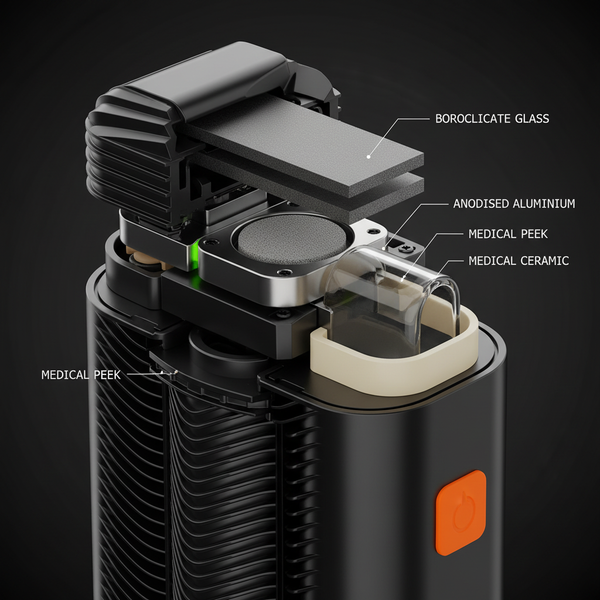
Device quality matters. Temperature control consistency varies significantly between devices.[12] A device that maintains stable temperature throughout a draw delivers more consistent extraction than one that drops temperature under heavy airflow and then overshoots during recovery. Medical-grade vaporisers are tested for temperature accuracy and consistency; consumer devices are not always held to the same standard.
The Complete Picture: Bioavailability by Route
| Route | Typical Range | Working Average | Time to Peak Effect | Duration | Key Advantage | Key Limitation |
|---|---|---|---|---|---|---|
| Smoking | 10–35% | 25–30% | 15–30 minutes | 2–4 hours | Familiar, accessible | 40–50% sidestream loss, 23–30% pyrolytic destruction, CO exposure |
| Vaporisation | 29–55% | 35–50% | 10–15 minutes | 2–4 hours | Highest efficiency, no combustion | Device-dependent, technique matters |
| Oral/Edibles | 4–20% | 6–10% | 30–90 minutes | 4–12 hours | Long duration, no inhalation | Unpredictable onset, first-pass metabolism, difficult to titrate |
The onset and duration differences have practical consequences beyond clinical pharmacology. A patient managing breakthrough pain needs relief in minutes, not hours — which makes inhalation the only viable route for acute symptom management. Conversely, a patient managing chronic overnight symptoms may prefer the extended duration of an oral preparation, accepting the slower onset in exchange for longer coverage.
Most medical cannabis patients in the UK are prescribed inhaled flower precisely because the onset profile allows the kind of dose titration that oral preparations cannot achieve.[10] The higher bioavailability of vaporisation compared to smoking means that prescribed quantities go further — a 30g monthly prescription vaporised delivers substantially more active cannabinoid to the bloodstream than the same quantity smoked would.
Caveats
Most vaporisation bioavailability studies are acute single-dose designs — they measure a single session, not the cumulative effects of daily use over months or years.[13] Sample sizes in foundational studies are small (Abrams 2007 used 18 subjects). Many studies used standardised pharmaceutical-grade cannabis; results with natural strain variation may differ. Older studies used lower-THC cannabis than is available today, and the pharmacokinetics of modern high-potency products may produce somewhat different results. CBD bioavailability data remains more limited than THC data.
The bioavailability figures in this article represent the best available evidence, but they are estimates derived from controlled laboratory conditions. Real-world results — with variable technique, variable devices, and variable starting material — will produce individual outcomes across a wider range.
Sources & Methodology
- National Center for Biotechnology Information. Bioavailability. In: StatPearls. Available at: ncbi.nlm.nih.gov/books/NBK557852/
- Huestis MA. Human cannabinoid pharmacokinetics. Chem Biodivers. 2007;4(8):1770-1804. doi:10.1002/cbdv.200790152. Available at: pmc.ncbi.nlm.nih.gov/articles/PMC2689518/
- Grotenhermen F. Pharmacokinetics and pharmacodynamics of cannabinoids. Clin Pharmacokinet. 2003;42(4):327-360. doi:10.2165/00003088-200342040-00003
- Hazekamp A, et al. Cannabis smoke condensate and crude cannabis flower: comparison of chemical composition. Cited ranges from multiple pharmacokinetic reviews. See also: MacCallum CA, et al. Practical strategies using medical cannabis to reduce harms associated with long-term opioid use. Can Fam Physician. 2024.
- Published bioavailability range (2–56%) reflects variability across subjects, products, and measurement methods. Conservative clinical range (10–35%) per Grotenhermen 2003 and Huestis 2007.
- Hazekamp A, Ruhaak R, Zuurman L, et al. Evaluation of a vaporizing device (Volcano) for the pulmonary administration of tetrahydrocannabinol. J Pharm Sci. 2006;95(6):1308-1317. doi:10.1002/jps.20574. Available at: pubmed.ncbi.nlm.nih.gov/16637053/
- Lanz C, Mattsson J, Soydaner U, Brenneisen R. Medicinal cannabis: in vitro validation of vaporizers for the smoke-free inhalation of cannabis. PLoS One. 2016. See also: PMC article on decarboxylation efficiency. Available at: pmc.ncbi.nlm.nih.gov/articles/PMC10249740/
- Abrams DI, Vizoso HP, Shade SB, et al. Vaporization as a smokeless cannabis delivery system: a pilot study. Clin Pharmacol Ther. 2007;82(5):572-578. doi:10.1038/sj.clpt.6100200. Available at: pubmed.ncbi.nlm.nih.gov/17429350/
- Spindle TR, Cone EJ, Schlienz NJ, et al. Acute pharmacokinetic profile of smoked and vaporized cannabis in human blood and oral fluid. J Anal Toxicol. 2019;43(4):233-258. Available at: pmc.ncbi.nlm.nih.gov/articles/PMC6676961/
- Oral bioavailability and patient preferences. See: Bruni N, et al. Cannabinoid delivery systems for pain and inflammation treatment. Molecules. 2018. Available at: pmc.ncbi.nlm.nih.gov/articles/PMC9116950/
- CBD bioavailability data from multiple pharmacokinetic reviews. Inhaled CBD mean bioavailability 31% vs oral 6%; AUC and peak concentration comparisons from controlled studies.
- Technique variables (temperature, draw duration, grind, pack density) informed by device manufacturer guidance and clinical vaporisation protocols.
- Research limitations acknowledged: small sample sizes, acute study designs, standardised products vs natural variation, historical THC potency differences.
Work Out the Maths for Your Own Usage
Plug your current flower consumption into the savings calculator and see what switching from combustion to vaporisation actually costs — or saves — over a year.
Calculate Your Savings →