Editorial · Fact-Checked
Dry Herb vs Extracts vs E-Liquid — Understanding the Difference
Three completely different technologies share a single misleading name. This is where they actually diverge.
Fact-checked by the HerbVape Editorial Team — April 2026
"Vaping" is a catch-all word hiding three fundamentally different devices: dry herb vaporisers (heat plant matter below combustion), extract pens (flash-vaporise 60–90% cannabinoid concentrates at higher temperatures), and nicotine e-cigarettes (aerosolise e-liquid containing PG, VG, flavourings, and nicotine). Conflating them is why the EVALI data and popcorn-lung scares keep getting misapplied.
Every vaping health debate collapses into coherence the moment you specify which of the three technologies is actually under discussion.
Every time a vaping health scare makes the news, the same question floods search engines: is my dry herb vaporiser dangerous? The answer depends entirely on which of three completely different technologies the headline is actually about.
"Vaping" has become a catch-all term that obscures more than it clarifies. It is used interchangeably for nicotine e-cigarettes, cannabis concentrate pens, and dry herb vaporisers — three devices with different mechanisms, different chemical outputs, different risk profiles, and different regulatory treatments. The EVALI crisis of 2019, the ongoing debate about teen nicotine use, and the emerging research into cannabis bioavailability all become incoherent when these categories are conflated. This article separates them.
The Three Categories Defined
Dry Herb Vaporisers
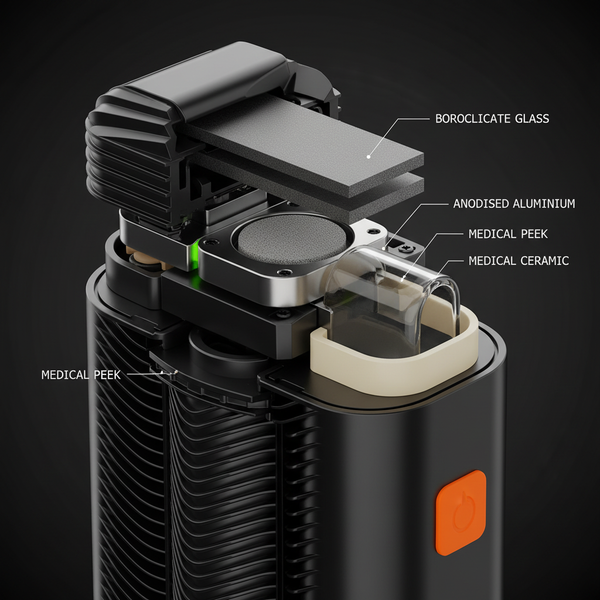
A dry herb vaporiser heats whole, dried plant material — typically cannabis flower — to temperatures between 150°C and 230°C (302–446°F), below the point of combustion. The heating method is either conduction (the material sits on a hot surface) or convection (hot air passes through the material), and many modern devices use a hybrid of both. The result is a vapour composed primarily of the volatile compounds released at the selected temperature: cannabinoids, terpenes, and flavonoids.
The MAPS/NORML Volcano study — one of the most frequently cited analyses of dry herb vapour composition — found that the output of a Volcano vaporiser at controlled temperatures consisted of approximately 95% cannabinoids (principally THC and CBN), with the remaining 5% comprising trace compounds including one suspected cannabinoid relative, one suspected polycyclic aromatic hydrocarbon, and the terpene caryophyllene.[1] By contrast, combusted cannabis smoke contains over 100 chemical compounds, including multiple carcinogenic polycyclic aromatic hydrocarbons (PAHs), carbon monoxide, and benzene.[1]
No additives, carrier liquids, or solvents are involved in the dry herb vaporisation process. The only input is heat and plant material; the only output is what that material naturally contains at the vaporisation temperature selected.
Extract and Concentrate Devices
Extract devices — sometimes called "dab pens," "wax pens," or concentrate vaporisers — use a heated coil or atomiser to flash-vaporise concentrated cannabis preparations. These concentrates (sold as wax, shatter, budder, live resin, distillate, or oil) contain between 60% and 90% cannabinoids, compared to 15–30% in whole cannabis flower.[2]
The mechanism is fundamentally different from dry herb vaporisation. Concentrates are typically heated to significantly higher temperatures — up to 470°C (878°F) in some devices — to vaporise the dense, viscous material.[2] The chemical composition of the output depends on the concentrate type, the solvent system used during extraction (butane, CO₂, ethanol, or solventless methods), and the thoroughness of the purification process. Poorly purged concentrates may contain residual extraction solvents.
Concentrates eliminate many of the combustion byproducts associated with smoking, but they introduce variables that do not exist in dry herb vaporisation: potential residual solvents, carrier oils (in some cartridge formulations), and the unknown long-term effects of inhaling 90%+ THC concentrations. This last point is not a settled risk — it is an acknowledged gap in the current research.
Nicotine E-Cigarettes
Nicotine e-cigarettes heat a liquid solution — e-liquid or "vape juice" — composed primarily of propylene glycol (PG) and vegetable glycerin (VG), with added nicotine and flavourings. In the United Kingdom, the maximum permitted nicotine concentration is 20 mg/ml under the Tobacco Products Directive (TPD).[3]
The output is technically an aerosol (suspended liquid droplets) rather than a true vapour, though the distinction is largely academic for the end user. The PG/VG base constitutes over 99% of the aerosol by mass, but analytical studies have detected approximately 2,000 distinct chemicals in e-cigarette emissions, the majority of which remain unidentified.[4] Among the identified compounds are several known carcinogens listed under California's Proposition 65, including acetaldehyde, benzene, cadmium, formaldehyde, isoprene, lead, nickel, and toluene.[4]
This is not an argument that e-cigarettes are more dangerous than smoking tobacco — the scientific consensus, supported by substantial evidence, is that they are significantly less harmful for adult smokers who switch completely.[5] It is, however, a clear illustration of why e-cigarette research cannot be applied to dry herb vaporisers, and vice versa. The inputs, the chemistry, and the outputs are fundamentally different.
The Comparison at a Glance
| Factor | Dry Herb Vapour | E-Cigarette Aerosol | Concentrate Vapour |
|---|---|---|---|
| Primary constituents | Cannabinoids (~95%), terpenes | PG/VG (>99%), nicotine | High-potency cannabinoids (60–90%) |
| Carbon monoxide | None or minimal | Present | Variable |
| Identified carcinogens | None identified in controlled studies | 10+ (Proposition 65 listed) | Variable; depends on source and purity |
| Chemical complexity | ~95% of output identified | ~2,000 chemicals detected, mostly unidentified | Depends on extraction method |
| Additives | None | Flavourings, nicotine salts | Possible carrier oils, terpene reintroduction |
| Operating temperature | 150–230°C (302–446°F) | Variable | Up to 470°C (878°F) |
| UK regulation | Outside TPD | TPD/TRPR regulated | Outside TPD (device); substance law applies |
The EVALI Crisis: What Happened and Who It Affected
Between August 2019 and January 2020, the United States experienced an outbreak of severe lung injuries linked to vaping products. The CDC documented 2,807 hospitalisations and at least 68 deaths.[6] Media coverage was extensive, and the term "vaping" appeared in almost every headline — without distinction between product types.
The cause was identified with considerable precision. Analysis of bronchoalveolar lavage fluid from 51 confirmed and probable EVALI cases found vitamin E acetate in 94% of samples.[7] This compound had been used as a thickening agent in illicit and informally manufactured THC oil cartridges — sold through unregulated channels, primarily in US states without legal cannabis markets. Eighty-two per cent of hospitalised patients reported using THC-containing products; the majority had obtained them from informal sources.[6]
Dry herb vaporisers were not implicated. Not a single confirmed EVALI case was traced to dry herb vaporisation.[6] This outcome is mechanistically predictable: dry herb vaporisation involves no liquids, no carrier oils, no thickening agents, and no solvents. There is nothing in the process to which vitamin E acetate could be added. The EVALI crisis was caused by a specific adulterant in a specific product category — illicit THC oil cartridges — and its relevance to dry herb devices is precisely zero.
This distinction matters because it is routinely lost in public discourse. A 2019 headline reading "Vaping Kills" likely referred to vitamin E acetate in black-market THC cartridges. A reader using a Mighty to vaporise prescribed cannabis flower was not — and is not — facing the same risk. Conflating the categories is not merely imprecise; it actively misinforms.
The PHE "95% Less Harmful" Claim
In August 2015, Public Health England published an influential independent expert review concluding that e-cigarettes were "around 95% less harmful than tobacco cigarettes."[8] The figure originated from a single expert panel paper by Nutt et al., in which a group of specialists ranked tobacco cigarettes at a harm score of 99.6 and e-cigarettes at approximately 4 — a relative reduction of roughly 95%.[8]
This finding has been influential in UK public health policy and has contributed to the broadly supportive regulatory stance toward nicotine e-cigarettes as a smoking cessation tool. That context is important and should be acknowledged.
What the finding does not do is transfer to cannabis vaporisation, despite frequent attempts to apply it. The reasons are structural, not trivial. The PHE assessment was based on expert opinion rather than empirical measurement — a legitimate methodology for a novel product category, but one that generates an estimate, not a measured fact. The comparison was between tobacco cigarettes and nicotine e-cigarettes, both of which involve nicotine as the active ingredient and PG/VG as the carrier medium. Cannabis vaporisation involves different active compounds (THC, CBD, and other cannabinoids), a different delivery medium (dried plant material, with no carrier liquid), different combustion chemistry, and a different regulatory context that has historically limited the scope of clinical research.[9]
None of this means that cannabis vaporisation is more or less harmful than nicotine e-cigarettes. It means that the comparison is not valid — the underlying variables are too different for the PHE figure to be applied across categories. Cannabis vaporisation has its own evidence base, which should be assessed on its own terms. For a detailed examination of that evidence, see Are Dry Herb Vaporisers Safe?.
Risk Profiles Compared: An Honest Assessment
Any honest comparison of these three categories must start by acknowledging what is not known. Long-term vaporisation safety data — for any of the three categories — remains limited, with most studies covering periods of less than six months. No single study has compared all three delivery methods in a single population under controlled conditions.[10]
With those caveats stated, the available evidence supports a general risk hierarchy.
Dry herb vaporisation has the most favourable evidence profile among the three categories for cannabis delivery. The MAPS/NORML study demonstrates a vapour composition dominated by target compounds with minimal unwanted byproducts.[1] Small clinical studies report improvements in chronic respiratory symptoms within approximately one month of switching from smoking to vaporising.[11] No combustion byproducts (PAHs, carbon monoxide, benzene) have been detected in dry herb vapour at recommended operating temperatures. The primary caveat is that long-term data remains limited — "safer than smoking" is well-supported, but the long-term effects of daily inhalation of any non-air substance warrant ongoing research.
Nicotine e-cigarettes occupy a well-evidenced position as a harm reduction tool for adult tobacco smokers. The PHE assessment, while based on expert opinion, is broadly consistent with the available empirical data.[5] The concerns are primarily around the ~2,000 unidentified chemicals in the aerosol, the known presence of several carcinogens (at levels far below those in tobacco smoke), and the population-level effects of nicotine uptake among non-smokers — particularly young people.[4] For adult smokers switching from tobacco, the evidence supports e-cigarettes as a substantially less harmful alternative. For non-smokers, the risk-benefit calculation is entirely different.
Concentrate vaporisation eliminates combustion byproducts but introduces variables that are less well-characterised. Residual extraction solvents, the effects of very high operating temperatures, and the unknown long-term consequences of inhaling 90%+ THC concentrations represent genuine knowledge gaps.[2] For medical patients using pharmaceutical-grade concentrates from regulated suppliers, the risk profile is likely more favourable than for consumers using products of uncertain provenance. The EVALI crisis demonstrated what happens at the extreme end of that provenance spectrum.
UK Regulatory Differences
The three categories receive markedly different regulatory treatment in the United Kingdom, a fact that has practical consequences for consumers.
Nicotine e-cigarettes are the most heavily regulated category. Under the Tobacco Products Directive (TPD) and the UK's Tobacco and Related Products Regulations 2016, nicotine e-cigarettes face mandatory MHRA notification, a maximum tank capacity of 2 ml, a maximum e-liquid refill volume of 10 ml, a nicotine concentration cap of 20 mg/ml, an explicit list of prohibited ingredients (including taurine, colourings, and caffeine), and mandatory health warnings on packaging.[3]
Dry herb vaporisers fall entirely outside the TPD framework, which applies only to nicotine-containing products. Dry herb devices are regulated as general consumer electronics under the General Product Safety Regulation (GPSR), UKCA/CE marking requirements, and standard consumer protection legislation.[12] The legality of use depends on the substance vaporised, not the device itself — a dry herb vaporiser is legal to purchase, possess, and use; cannabis remains a controlled substance unless prescribed.
Extract and concentrate devices occupy a similar regulatory position to dry herb vaporisers: the devices are legal consumer products; the legality of the substance depends on its composition. CBD concentrates containing less than 0.2% THC are legal. THC concentrates are illegal for recreational use and available only through medical prescription.
For a detailed examination of why this regulatory gap exists and what it means for consumers, see Why Dry Herb Vaporisers Aren't Regulated Like Nicotine Vapes.
What This Means in Practice
The practical takeaway is straightforward: when reading a headline about "vaping," the first question should always be which category of vaping the headline refers to. An EVALI report has no relevance to dry herb devices. A PHE harm reduction assessment about nicotine e-cigarettes cannot be applied to cannabis delivery. A concern about residual solvents in concentrates does not apply to whole-flower vaporisation.
For consumers choosing between these categories for cannabis use specifically, dry herb vaporisation currently offers the most favourable combination of identified vapour composition, absence of additives, moderate operating temperatures, and growing clinical evidence. Concentrates offer higher potency but with less well-characterised risk variables. The choice between them depends on individual priorities — but it should be an informed choice, made with an understanding of how fundamentally different these technologies are.
For those using nicotine e-cigarettes as a smoking cessation tool, the evidence supports continued use as part of a quit plan. The harm reduction case for adult smokers switching to e-cigarettes is well-established and should not be undermined by conflation with unrelated product categories.
The worst outcome of the "vaping" conflation is that it discourages people from making evidence-based decisions. A smoker who avoids switching to an e-cigarette because of an EVALI headline about THC cartridges, or a patient who avoids a prescribed vaporiser because of a study about nicotine aerosol chemistry, is making a decision based on misapplied evidence. Separating the categories is the first step toward better decisions.
Sources & Methodology
- Gieringer D, St Laurent J, Goodrich S. Cannabis vaporizer combines efficient delivery of THC with effective suppression of pyrolytic compounds. J Cannabis Ther. 2004;4(1):7-27. Study conducted under MAPS/NORML sponsorship using Volcano vaporiser. Available at: maps.org/research-archive/mmj/pr5.02.03.html
- National Academies of Sciences, Engineering, and Medicine. The Health Effects of Cannabis and Cannabinoids. Washington, DC: National Academies Press; 2017. Available at: nap.nationalacademies.org/24625
- UK Government. The Tobacco and Related Products Regulations 2016. SI 2016/507. Available at: legislation.gov.uk/uksi/2016/507/contents
- Goniewicz ML, Knysak J, Gawron M, et al. Levels of selected carcinogens and toxicants in vapour from electronic cigarettes. Tob Control. 2014;23(2):133-139. See also: House of Commons Library. "E-cigarette regulation." Research Briefing CBP-8114. Available at: commonslibrary.parliament.uk/research-briefings/cbp-8114/
- McNeill A, Brose LS, Calder R, et al. E-cigarettes: an evidence update. Public Health England; 2015.
- Centers for Disease Control and Prevention. Outbreak of lung injury associated with the use of e-cigarette, or vaping, products. Final update, 25 February 2020. Available at: archive.cdc.gov/www_cdc_gov/tobacco/basic_information/e-cigarettes/severe-lung-disease.html
- Blount BC, Karwowski MP, Shields PG, et al. Vitamin E acetate in bronchoalveolar-lavage fluid associated with EVALI. N Engl J Med. 2020;382(8):697-705. doi:10.1056/NEJMoa1916433
- Nutt DJ, Phillips LD, Balfour D, et al. Estimating the harms of nicotine-containing products using the MCDA approach. Eur Addict Res. 2014;20(5):218-225. Critical analysis: Eissenberg T, Maziak W. Are electronic cigarette users at risk? Tob Control. 2020. Available at: pmc.ncbi.nlm.nih.gov/articles/PMC8455704/
- See also: UCSF Center for Tobacco Control Research and Education analysis of PHE claims. Available at: tobacco.ucsf.edu
- No direct three-way comparative study across all delivery methods in a single population has been published. Most vaporisation safety data covers periods of less than six months.
- Van Dam NT, Earleywine M. Pulmonary function in cannabis users: support for a clinical trial of the vaporizer. Int J Drug Policy. 2010;21(6):511-513. See also: Earleywine M, Barnwell SS. Decreased respiratory symptoms in cannabis users who vaporize. Harm Reduct J. 2007;4:11.
- For a detailed examination of the UK regulatory framework for dry herb vaporisers, see: [Why Dry Herb Vaporisers Aren't Regulated Like Nicotine Vapes](/blogs/editorial/regulation).
New to Dry Herb? Start Here
If you're switching from a nicotine vape or a concentrate pen, the beginner-friendly dry herb devices have a completely different learning curve. Dennis's beginner roundup covers the ones that actually make the transition easy.
Best Vaporizers for Beginners 2026 →