Editorial · Fact-Checked
Cannabis Terpenes & Temperature — The Science Behind the Flavour
The flavour wheel, the molecular chemistry, and the temperature dial on your vaporiser are telling the same story.
Fact-checked by the HerbVape Editorial Team — April 2026
Cannabis contains 150+ terpenes, but 15–20 drive the experience. Each has a different boiling point, so the temperature you set on a vaporiser selects not just how much cannabinoid is extracted but which terpene profile you get. The boiling-point data is reasonably well-established for monoterpenes (limonene ~176°C, linalool ~199°C); sesquiterpenes show much greater variance across sources. This article maps the chemistry onto the dial.
Temperature selection isn't preference — it's chemistry. Lower temperatures favour brighter, terpene-forward expression; higher temperatures unlock heavier cannabinoids and sedative monoterpenes.
The sharp citrus burst at 176°C. The lavender calm at 199°C. The heavy earthiness at 210°C. Every temperature tells a different story — and the molecules responsible have names.
Terpenes are the aromatic compounds that give cannabis its distinctive flavour and scent. Over 150 have been identified in the cannabis plant, though only 15–20 appear in concentrations significant enough to influence the experience.[1] They are not unique to cannabis — myrcene gives mangoes their tropical sweetness, limonene defines the smell of citrus peel, and linalool is the primary scent compound in lavender. What makes terpenes interesting in the context of vaporisation is that each has a different boiling point, which means that the temperature selected on a vaporiser determines not just how much cannabinoid is extracted but which terpene profile accompanies it.
This article is the scientific companion to Dennis's Temperature Guide. Where Dennis writes from seven years of personal experience, this piece examines the chemistry underneath.
The Major Terpene Reference Table
The table below lists the terpenes most commonly encountered in significant concentrations in cannabis flower, along with their boiling points, flavour characteristics, and proposed effects. A note on confidence: boiling point data for monoterpenes (pinene, myrcene, limonene) is relatively consistent across sources, with agreement to within ±5–10°C. Sesquiterpenes (humulene, caryophyllene) show far greater variance — see the critical notes below the table.
| Terpene | Boiling Point (°C) | Boiling Point (°F) | Flavour | Proposed Effects | Confidence |
|---|---|---|---|---|---|
| Humulene | 106–198 | 223–388 | Spicy, woody, hoppy | Anti-inflammatory, appetite suppressant | Low |
| Caryophyllene | 119–260 | 246–500 | Spicy, peppery, clove | Anti-inflammatory, analgesic | Low |
| Pinene (α & β) | 155–160 | 311–320 | Fresh, piney, woody | Anti-inflammatory, memory support | Moderate |
| Myrcene | 166–168 | 330–334 | Earthy, musky, fruity | Sedative, relaxant, analgesic | Moderate |
| Limonene | ~176 | ~349 | Citrus (lemon, orange) | Mood elevation, stress relief | Moderate |
| Terpinolene | ~185 | ~367 | Herbal, piney, citrus | Energetic, uplifting, antioxidant | Moderate |
| Linalool | ~199 | ~390 | Floral, lavender | Sedative, anxiolytic | Moderate |
Why Some Boiling Points Show Wide Ranges
The humulene and caryophyllene entries warrant explanation, because the discrepancies are significant and widespread.
Humulene is commonly cited at approximately 100–106°C in cannabis industry resources — terpene supplier databases, cannabis retail sites, and popular vaporiser guides. However, other sources, including cannabis-specific editorial publications and chemical reference databases, list values as high as 198°C.[2] The lower figures appear to originate from commercial terpene suppliers (Floraplex, Zamnesia); the higher figures from editorial sources (The Leaf Online). PubChem and NIST data do not resolve the discrepancy cleanly. Humulene is a sesquiterpene — a larger, heavier molecule than the monoterpenes — and it may undergo decomposition rather than straightforward boiling at higher temperatures, which would explain why different measurement methods produce different results.[2]
Beta-caryophyllene shows an even more dramatic split. The cannabis industry consensus is approximately 130°C (266°F), but peer-reviewed fragrance safety data from RIFM (the Research Institute for Fragrance Materials) lists the boiling point at 253–262°C when corrected to normal atmospheric pressure.[3] The likely explanation is that the lower figure reflects the temperature at which caryophyllene begins to release measurable vapour (vapour release onset), while the RIFM figure represents the full boiling point under standard conditions. This distinction — between when a compound first becomes detectable in vapour and when it fully boils — explains why caryophyllene's spicy, peppery character is present in low-temperature vaping sessions even though its full boiling point is considerably higher.[3]
The practical implication for users is this: the "boiling point" figures in most vaporiser guides — including many widely shared infographics — should be understood as approximate temperatures at which each terpene becomes meaningfully present in the vapour, not precise physical constants. Monoterpene figures (pinene, myrcene, limonene) are reasonably reliable. Sesquiterpene figures carry greater uncertainty and should be treated as indicative ranges rather than exact targets.
The Entourage Effect: Promising, Contested, Evolving
The entourage effect — the hypothesis that cannabis terpenes interact synergistically with cannabinoids to modify the therapeutic experience — is one of the most discussed and most debated concepts in cannabis science. The evidence base has developed considerably since Ethan Russo's foundational 2011 paper in the British Journal of Pharmacology, which reviewed terpene-cannabinoid interactions and proposed synergistic effects across pain, inflammation, anxiety, depression, and several other conditions.[4]
Recent research has provided the first rigorous clinical support for the hypothesis. A 2024 double-blinded, placebo-controlled crossover study conducted by Johns Hopkins University and the University of Colorado found that vaporised D-limonene (15 mg) combined with THC (30 mg) significantly reduced self-reported anxiety and paranoia ratings compared to THC alone.[5] The study authors described their findings as providing some of the first clinical evidence supporting the validity of the entourage effect. Separately, a 2025 Israeli study assessed 16 cannabis terpenes and found significant dose-dependent responses at both CB1 and CB2 cannabinoid receptors — the first research to characterise terpene interactions at CB2 receptors specifically, with activation reaching 10–60% of THC levels.[6]
The counter-evidence, however, remains substantial. A 2024 scoping review by Simei et al., published in Cannabis and Cannabinoid Research, concluded that the literature provides limited evidence to support the entourage effect as a stable and predictable phenomenon, describing the overall findings as contradictory and inconclusive.[7] A 2020 study published in Frontiers in Pharmacology found no entourage effects mediated through CB1 or CB2 receptor mechanisms.[8]
The honest editorial position is that the entourage effect is promising and increasingly supported by high-quality evidence, but not yet conclusively established. The limonene-anxiety study is methodologically strong and directly relevant to vaporiser users. The overall body of evidence, however, remains contested. Users who select temperatures to preserve specific terpene profiles are making a reasonable choice based on emerging science — but they should not assume the effects are guaranteed.
Temperature Windows: What Changes and Why
The relationship between temperature and experience is not arbitrary — it reflects the sequential release of different compounds as heat increases.
Low Temperature: 160–180°C (320–356°F)
At the bottom of the vaporising range, the monoterpenes dominate. Myrcene, limonene, and pinene — the lightest, most volatile terpene molecules — release readily at these temperatures, producing bright, flavourful vapour with a lighter body feel.[9] THC extraction is incomplete at this range; the experience tends toward a clearer, more cerebral effect. The evaporation rate at 160°C is approximately three times lower than at 200°C, which means longer sessions and thinner visible vapour — less material is extracted per draw, but what is extracted is terpene-rich.
Medium Temperature: 180–200°C (356–392°F)
This is the range most often cited as the balance point. Cannabinoid extraction increases significantly, heavier terpenes including linalool (boiling point ~199°C) begin to release, and the overall experience shifts from the predominantly flavour-driven low range toward a fuller, more rounded effect.[9] Most clinical vaporisation studies use temperatures in this window — the Abrams 2007 Volcano study, for example, used 200°C.
High Temperature: 200–220°C (392–428°F)
Maximum cannabinoid extraction occurs in this range, producing denser vapour and more pronounced physiological effects. The trade-off is terpene degradation — at these temperatures, many of the lighter terpenes that dominated the low range have been exhausted or broken down, and the flavour shifts toward a heavier, more generic character.[9] This range favours users prioritising potency over flavour.
The Degradation Threshold: Above 220°C (428°F)
Above 220°C, both terpenes and cannabinoids begin to degrade at accelerating rates. The MAPS/NORML study found complete elimination of benzene, toluene, and naphthalene at 200°C, but at temperatures exceeding 400°C these harmful compounds form rapidly.[10] Methacrolein — an irritant compound — is undetectable at 322°C (612°F) but appears at temperatures above 400°C.[10] The practical safety threshold for dry herb vaporisation is generally considered to be below 230°C, with diminishing returns in both flavour and safety above that point.
The Safety Boundary: Where Flavour Ends and Risk Begins
The degradation threshold is not just a flavour concern — it is a safety boundary. At typical vaporising temperatures (170–210°C), the MAPS/NORML Volcano study found vapour consisting of approximately 95% cannabinoids with no detectable benzene, toluene, or naphthalene.[10] Above this range, the picture changes.
| Compound | Formation Threshold | Notes |
|---|---|---|
| Benzene (carcinogen) | ~400°C (752°F) | Minimal at 322°C; exponential increase above 400°C |
| Methacrolein (irritant) | >400°C (752°F) | Undetectable at 322°C |
| Isoprene | Elevated temperatures | Primary precursor to benzene; forms from myrcene oxidation |
| Carbon monoxide | Combustion (~230°C+) | Minimal below combustion threshold |
The practical lesson is clear: staying below 220–230°C (428–446°F) keeps the session within the well-characterised safety zone. Above that threshold, the returns diminish rapidly — less terpene expression, accelerating degradation of cannabinoids, and the initial appearance of compounds that are entirely absent at recommended temperatures. For users who value both flavour and safety, there is no reason to push beyond 210–215°C for the final draws of a session.
Recent research (2024–2025) has added further detail. A 2025 systematic review of thermal degradation products in cannabis concentrate vaping — which operates at far higher temperatures than dry herb vaporisation — documented the specific degradation pathways that become active above 400°C.[10] A terpene stability study by Raeber et al. (2025) provided comprehensive analysis of chemical stability in cannabis flowers during growth and storage, establishing baseline data for understanding how terpene profiles evolve before the material reaches the vaporiser.[12]
How Heating Methods Affect Terpene Delivery
The vaporiser's heating mechanism influences terpene preservation independently of the temperature setting.
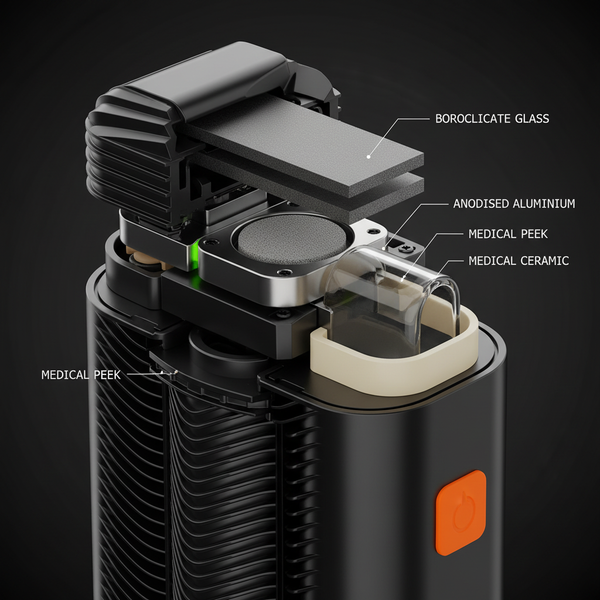
Conduction heating places the plant material in direct contact with a heated surface. This produces immediate heat transfer and fast extraction, but creates localised hot spots where the material touching the surface is heated more intensely than material further away. The result can be uneven extraction and poorer terpene preservation — the material nearest the heater may reach higher temperatures than the display indicates, while material at the centre of the chamber is under-heated.
Convection heating passes hot air through the plant material without direct surface contact. The heating is more even, reducing localised degradation and preserving a broader terpene profile. Convection devices typically produce brighter, more defined flavour — the Tinymight 2, a primarily convection device, is frequently cited by users for its terpene expression.
Hybrid heating — the dominant trend in 2025–2026 device design — combines conduction (to heat the material immediately upon activation) with convection (to even out the extraction during the draw). The goal is full-spectrum extraction without the burnt notes that pure conduction can produce at higher temperatures.
It should be noted that limited peer-reviewed comparative research isolates terpene delivery profiles between heating methods.[11] The descriptions above reflect the engineering principles and the strong consensus of experienced users, but controlled laboratory comparisons remain a research gap.
What This Means for Sessions
For users interested in exploring how temperature affects their experience, the practical starting point is simple: begin a session at the low end (170–175°C / 338–347°F), spend a few draws experiencing the terpene-rich, flavour-forward profile, then step the temperature up in 5–10°C increments. Each step changes the character of the vapour — less citrus and floral, more density and potency. By 210°C (410°F), most of the extractable material has been released.
Stepping up through the temperature range within a single session — sometimes called "temperature stepping" — is not just a flavour exercise. It also provides a practical illustration of the terpene reference table: the compounds listed at lower boiling points dominate the early draws, while the heavier sesquiterpenes and the bulk of the cannabinoid content appear as temperature increases.
For a personal, experience-driven guide to temperature selection — including specific recommendations for different use cases — see Dennis's Temperature Guide.
Sources & Methodology
- Booth JK, Bohlmann J. Terpenes in Cannabis sativa — From plant genome to humans. Plant Sci. 2019;284:67-72. doi:10.1016/j.plantsci.2019.03.022. See also: Sommano SR, et al. The cannabis terpenes. Molecules. 2020;25(24):5792.
- Humulene boiling point data. PubChem Compound Summary: pubchem.ncbi.nlm.nih.gov/compound/Humulene. NIST Chemistry WebBook: webbook.nist.gov/cgi/cbook.cgi?ID=C6753986&Mask=4
- Beta-caryophyllene boiling point data. PubChem: pubchem.ncbi.nlm.nih.gov/compound/Caryophyllene. RIFM Safety Assessment: pubmed.ncbi.nlm.nih.gov/34848252/
- Russo EB. Taming THC: potential cannabis synergy and phytocannabinoid-terpenoid entourage effects. Br J Pharmacol. 2011;163(7):1344-1364. doi:10.1111/j.1476-5381.2011.01238.x
- Johns Hopkins / University of Colorado limonene-THC study. Published in Psychopharmacology, 2024. See: drexel.edu/cannabis-research/research/research-highlights/2024/April/study-shows-clinical-evidence-entourage-effect-thc-limonene/
- Israeli terpene-receptor binding study, 2025. 16 cannabis terpenes assessed at CB1 and CB2 receptors. See: norml.org/news/2025/11/20/analysis-cannabis-terpenes-act-as-agonists-on-endogenous-cannabinoid-receptors/
- Simei M, et al. The entourage effect: a scoping review. Cannabis Cannabinoid Res. 2024. doi:10.1089/can.2023.0052
- Santiago M, et al. Absence of entourage: terpenoids commonly found in Cannabis sativa do not modulate the functional activity of Δ9-THC at human CB1 and CB2 receptors. Front Pharmacol. 2020;11:359.
- Temperature windows informed by terpene boiling point data and clinical vaporisation protocols. See sources [1]–[3] and cannabis pharmacology reviews.
- Meehan-Atrash J, et al. Toxicant formation pathways in dabbing cannabis concentrates. ACS Omega. 2017;2(9):6112-6117. doi:10.1021/acsomega.7b01130. MAPS/NORML vapour analysis data.
- Raeber JL, et al. Chemical stability of terpenes in Cannabis sativa flowers. Phytochem Anal. 2025. doi:10.1002/pca.3432. See also: Frontiers in Toxicology systematic review of cannabis concentrate vaping chemistry, 2025.
- No published peer-reviewed comparative study isolating terpene delivery profiles between conduction, convection, and hybrid heating methods was identified. Descriptions reflect engineering principles and community consensus.
Want a Device That Reveals These Terpenes?
Pure convection with a clean airpath is the only consumer-level technique that expresses a cultivar's real terpene stack. Dennis's flavour-focused roundup is where you start.
Best Vaporizers for Flavour 2026 →